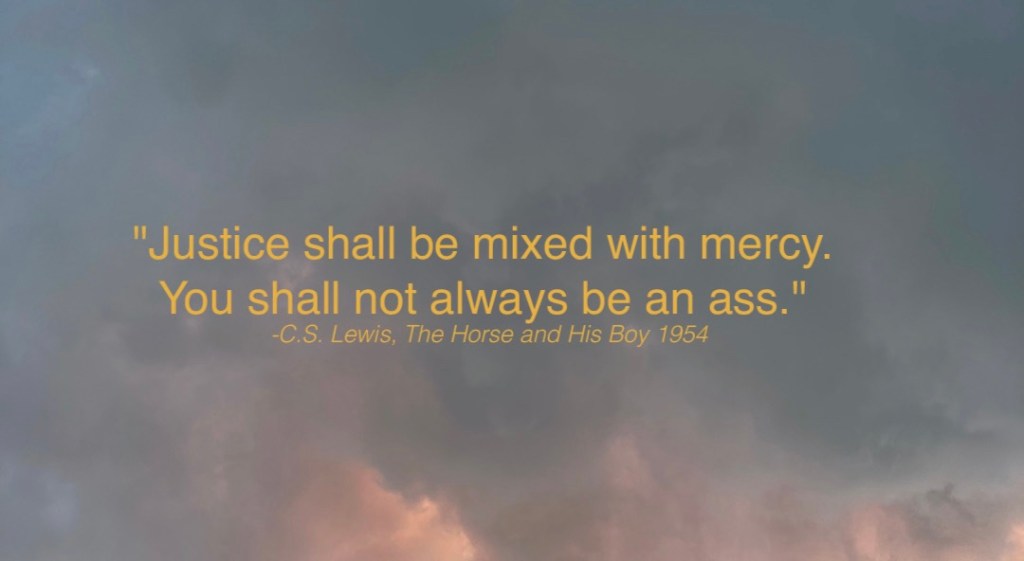
“Justice shall be mixed with mercy. You shall not always be an Ass.” -C.S. Lewis, The Horse and His Boy 1954
Upon capture for his crimes against Narnia, Rabadash was brought in chains to the Kings and Queens of Narnia for judgment. His fate no doubt was deserved, for traitors deserve death. And yet Queen Lucy and King Edmund, in the wisdom that could only be gained through an encounter with Aslan, proposed mercy instead of vengeance. Rabadash in his pride could not hear the mercy being offered by Queens and Kings of honor, for his shame from being caught was too grand and his heart too callous. The warning was not heeded, Aslan himself came to judge and enact justice. A justice that only revealed what was already there, turning a king into an ass, for he already had dishonored himself to the point of folly.
And yet, even in Aslan’s judgment, he remained as merciful as he was just and as kind as he was stern. The king need not remain a donkey all the days of his life, but he would not be allowed to venture off into boundless foolishness as he had before. Aslan’s magic would revert Rabadash to his human form if he stayed within the bounds he should.
What a fickle thing it is, to find ourselves the likes of Rabadash in our own stories. Our own desperation leads us to conquer rather than receive. Our pride blinds us to the feast of grace and mercy before us, illuminating only our shame and fear which ushers us into further destruction. We are no less wicked than a king refusing to hear mercy, no less foolish than a man who has made an ass of himself.
From the dawn of our history, we have made a mockery of the unity we share in Christ. The Church has bickered and grown cold with one another. Saint Paul and Saint Barnabas led the way of the Church in unsightly disagreements leading to broken relationships. The Great Schism and the Reformation led to our current state – the most divided Church in all of history. And still today, our denominations are splitting one after another. Methodists, Baptists, Anglicans, Lutherans. We seem to only see the things which separate us, and forget the things which unite us.
Our sins go further than denominational divides. We are abusers and liars. We seek control and comfort. Our pride leads us to believe we can accomplish peace without love. We fail to be honest and fail to be kind. The wounds of our messiness become irreparable and turn our laughter into tears. Brothers are separated, and friendships are forced to die.
And yet, justice mixes with mercy. We are destined perhaps to transform into the very things we mock but by God’s grace, we are not left to be a beast forever.
It is perhaps justice, that the church remains in pain from our division. We have become so prideful as to preclude others from sharing in the Lord’s table. We have forced one another into becoming the enemy. Each side in turn is the schismatic brethren, neither is without faults. And therefore we each claim the Lord is on our side, that he is in, or present with our eucharist. We are revilers of our family, spitting curses and screaming heresy without remorse. We fail to see the need for each other, and we grow colder because of it. In attempts to claim one virtue more valuable than another, we lose our righteousness altogether. We have truly made fools of ourselves, transforming into asses in the process.
Yet this justice mixes with mercy. We shall not always be an ass. Mercy trickles through our divisions like light through stained glass windows. God’s graces are demonstrated through the outstretched arms of brotherhood. Through shared prayers and repeated confessions. Mercy is felt through the waters of baptism, which extend beyond any denominational split or imprudent words. The trickle of holy water on foreheads reminds us all, we are born of the same womb. The sign of the cross marks us siblings of high importance. Mercy is seen even in our donkey state, in the blessings we offer each other instead of blood and body. Our arms are crossed in stubbornness, while our spirits crave the prayers of the righteous.
As Rabadash upon his purification was bound to his town, we are perhaps bound to our tribes. On good days we are called Rabadash the peacemaker, but everyone knows we are truly Rabadash the Ridiculous, for the mockery of our disunity can not be forgotten by the world.
Justice mixes with mercy, and we remember our hope is not in this life but in the one to come. The eschaton that will bring ultimate unity, wash away all senseless disagreements, and heal all our wounds. Holy waters remind us that the kingdom is already and not yet. As priests splash our feeble bodies, we are united, awaiting the days when we can swim in the waters that only splash our skin.
I am a firm believer in the importance of precise language. I have seen time and time again Christians fall into divisions, disunity, and outright chastisement of each other because of confusion around the use of language. This issue of language is perhaps most prevalent in Christian conversations around LGBTQ+ issues.
Over my 24+ years in Church, I have witnessed arguments of language dominate conversations around faith and sexuality. As a result of this absolutism, I believe the Church has missed a vital opportunity to minister and disciple entire populations of the Church. In this blog, I want to make a case for why we should stop policing Christians’ use of terms such as “gay Christian”, and how that can perhaps actually lead to greater discipleship and clarity around what a Christian sexual ethic can actually look like. I know I may have already caused some of you to cringe, get angry, or be skeptical. I realize many of you probably clicked on this post purely to argue against its provocative title, or because you wanted to read for yourself how I have “lost my way”. I hope and pray that you will stick around to read the entire post before making any rash judgments.
The Merriam-Webster dictionary would define ‘gay‘ and similarly ‘queer’ as “of, relating to, or characterized by sexual or romantic attraction to people of one’s same sex”, a definition which could be simplified to mean “a male who is attracted to other males or a female who is attracted to other females”.
If you asked any pastor in the Western world, “Could someone who experiences attraction to the same sex still be a Christian?” you would in most cases receive an enthusiastic “Yes!”. In every Christian tradition throughout all of the Church’s history Christianity has never required any lack of sexual or romantic attraction towards the same sex or otherwise. Why then have many in the church, including entire denominations, claimed that to identify as a “gay Christian” is inconsistent with a Christian witness?
If you do not have experience in the evangelical church this concept may be completely foreign to you. As most of the secular Western world sees it, identifying as queer is comparable to any other identifier such as Hispanic, disabled, father, wife, etc. Meaning, that being part of the LGBTQ+ community should have no more to do with your ability to be a Christian than being a part of a particular ethnic group or even being straight for that matter. In recent years in much of the Western Church, however, identifying as gay has often been criticized as being incompatible with the Christian faith.
This phenomenon is a rather recent argument made by people within the Church. As late as 1975, leaders like Billy Graham publicly backed ordaining gay Christians. He said as much in an article in the Atlanta Journal-Constitution titled, “Billy Graham Backs Ordaining Homosexuals”. He was asked by a journalist if he would support the ordination of a gay man to the Christian ministry, and he replied by speaking to the character of the man rather than his sexual orientation. He went on to say that requirements for Christian ministry rather than identifying as heterosexual were “turning away from their sins, receiving Christ, offering themselves to Christ and the ministry after repentance, and obtaining the proper training for the job.” 1
John Stott advocated for a distinction between how Christians viewed sexual orientation and sexual ethics in a 1978 sermon, later collected in a book titled, Issues Facing Christians Today. He argued that sexual orientation is generally unchosen and relatively fixed, saying, “We may not blame people for what they are, though we may for what they do,” He went on to say, “In every discussion about homosexuality we must be rigorous in differentiating between this ‘being’ and ‘doing’, that is, between a person’s identity and activity, sexual preference and sexual practice, constitution, and conduct.”2
Many other Christian leaders spoke fondly of the gay community, all without compromising on their tradition’s view of a Christian sex ethic. C.S. Lewis spoke of one gay man as his ‘oldest and most intimate friend” 3. Francis Schaeffer along with many other evangelicals at the time opposed the ordination of sexually active queer men and women, yet made a clear distinction between someone’s orientation, and their sexual practices and ethics. He stated in a 1968 letter to a European pastor, “By definition, to be a homophile (a gay person) is a person who is born so that they have a natural tendency toward affection and sexual practice with their own sex… Not all homophiles practice homosexuality and not all who practice homosexuality were born homophiles.” 4
It wasn’t until the 1990s that an alternative way of discussing Christians who experienced attraction to the same sex was birthed. To this day, many Christians argue that the only faithful way of discussing or describing their experience of homosexuality is by identifying as “Same-Sex Attracted”, or in some cases simply saying they struggle or wrestle with same-sex attraction. Entire denominations put out statements implying this to be the only orthodox way of describing the queer experience while adhering to a historic Christian sexual ethic. 5
Given the intensity with which Western Christians seem to back the language of “same-sex attraction” over other queer identification, it may come to be a surprise that this description of people with a queer sexual/romantic orientation was not created by Christians at all. The first time we see any use of the term “same-sex attraction” was in the early 1980s used by secular sex researchers in clinical literature.6 Following its appearance in clinical sex research, secular therapists used the term as a means of conversion therapy. It wasn’t until 1994 that any reference to “same-sex attraction” appeared in religious circles. In the Mormon book titled Born That Way? A True Story of Overcoming Same-Sex Attraction, Erin Eldridge used the term in a nonclinical way within the context of an ex-gay conversion ministry a part of Mormonism.7 Three years later, Garrick and Ginger Hyde would publish a book titled A Place in the Kingdom: Spiritual Insights from Latter-day Saints about Same-Sex Attraction that used the language of “struggling with same-sex attraction” as a means of furthering the ex-gay movement known for harmful conversion therapy practices.8 It was not until the early 2000s that Protestants began to appropriate the term coined by secular sex researchers and popularized by Mormons promoting conversion therapy. Many of the early protestant uses of the phrase were linked to conversion therapeutic practices and ex-gay ministries.9 Most of these ministries were later discredited after it came out that attempts at sexual orientation changes were nearly entirely ineffective.10
The surprising roots of the term “same-sex attracted” have not kept it from becoming the main phrase many evangelicals demand people use in order to be accepted into churches and denominations. This fact is surprising given the evangelical tendency to shy away from the use of practices rooted in secular or non-Christian ideology. This form of gatekeeping is often a main source of tension between the queer community and the evangelical church. While various traditions and denominations hold to various interpretations of the Christian sexual ethic, the policing of language seems to be the center of most debates surrounding the queer community and Christian faith. According to Andrew Martin, 76% of LGBTQ+ people who have left the Christian faith are open to returning, a jarring jump from just 9% of the general population.11 For many in the LGBTQ+ community, leaving a church or even the faith entirely had little to do with an unwillingness to participate in the tradition’s sexual ethics. Instead many leave as a result of being discriminated against for their attractions, orientation, or the way in which they identify or act outside of sexual activity.12
Seeing that disagreements around sexual ethics seem to be less pressing for those who are leaving the Church in droves, the question arises why churches and individuals would hold so tightly to these sex researchers, conversion therapists, or perhaps generously, Mormon terms of sexuality. Without addressing the Church of Latter-day Saints further, which to this day has a statement forbidding queer identification13, many Protestant Christians still prefer the “same-sex attraction” terminology. Many even argue that to identify as lesbian, gay, bisexual, transgender, queer, etc. is antithetical to the Christian witness. That it is placing identity in sin rather than in Christ14. There are several major issues with this interpretation.
Identifying as queer does not inherently mean identifying with sin. While the debate has been growing in recent years on whether the historic interpretation of scripture is an accurate and helpful one for a modern Christian sex ethic, identification within the queer community is not synonymous with a particular sexual ethic or activity. As previously noted, for most of the Christian world prior to the infamous “ex-gay movement”, referring to sexual orientation had no moral value apart from a further statement about one’s sexual activity. Furthermore, apart from some Christian circles, most people follow the plain definitions of gay, lesbian, and queer. Put simply, to be gay is simply to be someone attracted to the same sex as you, which in most of Western secular culture holds no moral weight or particular sexual ethic.
To insist that identifying as queer means one is renouncing the Christian faith is inconsistent with the Church’s general stance on other so-called “identification with sin”. There seems to be no substantial pushback on the rather successful program for those battling alcohol addiction. Alcoholics Anonymous, originally started by Christian influence, is known widely for its first step to recovery: admitting you are an alcoholic.15 Churches across the world have historically partnered with and participated in Alcoholics Anonymous. This seems to contradict the assertion that not identifying with sin is essential to the Christian faith.
The assertion that someone cannot identify with a so-called sin, is also inconsistent with scripture. Listed among the Hall of Faith in Hebrews 11, is “Rahab the prostitute”. Even if the identification as queer held inherent sexual deviance that was seen as sinful in a Christian sexual ethic, we can clearly see that identification with one’s sexual deviance does not exclude someone from the kingdom of God. In fact, Rahab’s listing among the other heroes of faith is perhaps a clear indication that one’s identification with a marginalized group associated with sexual defiance can be a witness to the world of the redeeming power of Christ. Perhaps the queer-identifying Christian, like Rahab, can be a symbol of the gospel, which does not require more than faith and allegiance to Christ. Perhaps the identity of a sexual minority does negate the title of faithful one.
Seeing beyond even this debate, one could point out the faults in teachings on “identity”. The prominent message of “identity in Christ” is a rather new concept. In fact, upon searching for Christian teachings on “placing identity in Christ” it is nearly impossible to find any relative messages prior to the 1980s.16 This is in large part due to the rise of the self-focus that the late 1900s brought to the Western world.
Arguments made that we must place our “identity” in Christ often carried the negative side effect of undermining other identities given to us through scripture by God, such as that of sons, daughters, mothers, and fathers. While scripture lifts up the specific and important roles that various members of a family hold, arguments that our identity should be in Christ alone seem antithetical to the emphasis placed on particular identities within the family of God. Additionally, to make the argument that one is not part of a particular nationality is to negate the specific time and boundaries which God created for that person to reside in (Acts 17:26).
Alternatively, teaching union with Christ (Colossians 3:3-4) offers a far more theologically robust contemplation of the Christian life. Union with Christ does not require that we set aside the other identities we hold, but rather that they be joined with him. The Gentiles did not forgo their ethnic identity but rather were unified with Christ in their Gentile identity. In fact, the highlighting of the difference between Jew and Gentile was perhaps critical to the furthering of the gospel and the growth of the early Church. Rahab need not shed the title of a prostitute, for her union with God through her faith placed her within the kingdom of God. Union with Christ supposes a far greater truth for us, that when we become in Christ when we are baptized into this faith, we are unified with him. This truth proclaims good news for all; for Rahab, who was unified with Christ even carrying the identity of a prostitute, for the mother who is unified with Christ yet does not lose her motherhood distinction, and her God-given calling as a mother, and for the queer woman who has been attracted to women her whole life, yet comes under the Lordship of Christ. If you desire to learn more about the distinction between identity in Christ and union with him, Caleb Morell offers fantastic insight in his article, Stop Finding Your Identity in Christ.17
Some may beg the question, why is identifying as queer important? People may carry a variety of personal reasons, but perhaps the most important of reasons someone may give is also the most jarring one. According to the Injury Control Research Center at West Virginia University in Morgantown, research has shown that queer people who stay in Church are 30-55% more likely to die by suicide if they stay within the Church than if they leave.18 Notably, in other studies of every population besides those who identify as LGBTQ+, suicide risk decreases with Church involvement.19 For many, being told they cannot be a gay Christian is interpreted as them being deemed ineligible to receive the free gift of eternal life. For many young people whose homosexual orientation seems to be relatively fixed, (that is in most cases) being told they cannot be queer and Christian is analogous to being told they cannot be a Christian. There seems to be no hope offered for those who wish to follow Christ, but cannot seem to see substantial change in their orientation.
Language is of vital importance in this conversation, because if we are not precise with our language, we are effectively teaching a false gospel, one that excludes the marginalized, and ostracizes the sexual minority. While different traditions and denominations have varying interpretations of what the Christian sexual ethic entails, to assert that one cannot be gay and Christian is to preach an exclusionary gospel. It may be entirely possible to welcome and support many queer Christians, without changing the Christian sexual ethic upheld in your tradition. In fact, many LGBTQ+ identifying Christians desire to be included and wanted within various traditions with more conservative sexual ethics. For those desiring to submit to a traditional Christian sexual ethic, having space for queer identification could be the difference between someone staying faithful throughout their life, or walking away due to a false understanding of the gospel.
If you desire to learn more about the history of queer identification within the Christian tradition, the scandal of the ex-gay movement, or following a historic Christian sexual ethic as a sexual minority I recommend the following resources:
Still Time To Care: What We Can Learn from the Churches Failed Attempt to Cure Homosexuality By Greg JohnsonPeople To Be Loved: Why Homosexuality is not Just an Issue By Preston SprinkleNetflix’s “Pray Away”: Beware of False Dichotomies By Pieter Valk (Originally published by The Center for Faith, Sexuality, and Gender)
Side B Christians Like Me Are An Asset Not a Threat By Bekah Mason (Originally published by Christianity Today)
Sources:
1: UPI, “Billy Graham Backs Ordaining Homosexuals,” Atlanta Journal Constitution, July 25,1975, 21.
2: Stott, Issues Facing Christians Today, 303.
3: C.S. Lewis, Surprised by Joy (New York: Houghton Mifflin Harcourt, 1956), 97.
4: Francis A. Schaeffer, Letters of Francis Schaeffer (Westchester, IL: Crossway, 1985), 193-95.
6: A 2021 Google n-gram search of the phrase “same-sex attraction” showed almost no use of the term in volumes within Google Books before 1981.
7:Erin Eldridge, Born This Way? A True Story of Overcoming Same-Sex Attraction (Salt Lake City: Deseret, 1994).
8:Garrick Hyde and Ginger Hyde, A Place in the Kingdom: Spiritual Insights from Latter-day Saints about Same-Sex Attraction (Salt Lake City: Century,1997).
9:Richard Cohen, Coming Out Straight (Oakhill Press, 2001).
11:Marin, Andrew P. US versus us: The untold story of religion and the LGBT community. Colorado Springs: NavPress, 2016.
12:Woodell, Brandi, and Philip Schwadel. 2020. “Changes in Religiosity among Lesbian, Gay, and Bisexual Emerging Adults.” Journal for the Scientific Study of Religion 59 (2): 379–96. https://doi.org/10.1111/jssr.12653.
3 responses to “A Case for Queer Identification among Christians”
Mateo
Question concerning the concept of identity: How would you interpret “a renewal in which there is no distinction between Greek and Jew, circumcised and uncircumcised, barbarian, Scythian, slave and freeman, but Christ is all, and in all.”
Colossians 3:11 NASB1995
When specifically discussing Gentile and Jewish identity, I think looking at the context of scripture is important. I tend to lean more towards the interpretation that “Jew nor Gentile” does not negate the realities of culture, but is rather promoting a diversity within body of Christ. We are all one in Christ, yet bring with us differences or ‘identities’.
This was one of the major problems within the early Church, Jews and Gentiles attempting to discern what needed to change for participation within Christianity. Some wanted men to be required to circumcised, but Paul addressed that clearly. Circumcision was no longer a requirement of holiness, but a mark of Jewish culture and identity.
This article I believe does a good job to getting into the particulars of interpretation and exegesis more than I am qualified to speak to. I found it helpful for thinking through this discussion. I recommend giving it a read for a more in depth answer from a more qualified thinker.
In terms of how this might apply to sexual orientation as identity, I believe the comparison is a reasonable one. Gentile converts were at the center of controversy because for Jewish people, the very idea of a Gentile seemed synonymous with sin. We see however, that the gospel broke past that barrier and made a way for Jew and Gentile to both inherit the kingdom of God. Gentiles were not forced to become Jews to be one with Christ, rather Jew and Gentile alike were made one with Christ through faith. I would make the argument that in the same way, there is neither gay Christian nor straight Christian (opposite-sex attracted Christian, nor same-sex attracted Christian) but Christ is all, and in all.
Just as Gentile and Jew must submit their lives, allegiance, and obedience of Christ, so do both straight and gay people. Just as the Jew and Gentile must surrender their lives, so also do gay people and straight people (which includes the brokenness in everyone’s sexuality) to Christ’s Lordship.
It is on days like today that we recognize and remember that the earth groans, long awaiting her Lord to set her free from the bondage she is in as a result of the sins of man. As climate change looms over us with its daunting irreparability, we become utterly aware of our sins.
It was humankind set to rule the earth. We, being image-bearers, made in the likeness of God were created to care for the nature into which God’s spirit was breathed. For just as we were given breath and made living creatures ( or nephesh chayah נפש חיה ), so also are the beasts of the earth, the fish of the sea, the birds of the air, and every living thing. We all carry the breath of God, humanity and all of nature, all of the living creatures or nepheshot chayot are animated by the Great Spirit. And yet, a select and holy few, the image-bearers of the Holy Elohim were set apart to care for the earth.
What a great transgression, that we’d rule with cruel and greedy hands. Instead of toiling with care, we’d strip the earth of her resources so that we could gain wealth. Instead of offering tender affection for the beasts of the fields, we’d stuff them in cages too small and slaughter their young so that we might be gluttonous and wasteful. Instead of using the energy given to us from the very essence of the divine, the breath of his lungs which blows across the land, the great light of his word which offers life, the refreshing waters of his spirit, we mine the ground pillaging that which we had no right to abuse. And as we transgress, creation groans. Wildfires rage as if attempting to purify the land. Tsunamis devastate the shores as if making attempts to refresh her wounds. Hurricanes grow and swell as if reminding us of the winds of God that animated us to begin with. Desert lands long for water, while oceans rise and cities flood.
And so the earth groans, and we groan with it. For we know, that the earth will not find the fullness of relief it needs without the return of the King. Yet, even so, are we not the sons of Elohim? Are we not the ones trusted to look after the earth and all her beauty? Perhaps amidst our groaning, we might offer relief to creations groaning. For what if when the messiah said that the kingdom was at hand, he meant that the earth’s groaning could be relieved. What if when he said greater works would be fined he spoke of pockets of creation singing. What if when he said that it would be better for him to leave, he spoke of the Spirit’s work amidst the church to redeem the land. For if Christ was able to tame the wild, could his image-bearers also?
In recent years, as I have continued to learn from female theologians and thinkers, I am discovering more and more how much I have lacked when the only voices listened to are male. For just as the people of God are neither greek nor jew, they are neither male nor female. Just as we are missing a rich theological insight if we do not listen to our brothers of color, we are devoid of insight into God if we refuse to listen to the women in our lives and churches.
And while often men like to quote Paul’s 1 Corinthians 14 34-35, and 1 Timothy 2:11-14 as justification for their silencing of women, they ignore Paul, and others’ exhortations of women apostles, teachers, leaders, public speakers, and prophets alike. (see Romans 16, Ephesians 5, Colossians 3, John 20, Matthew 28, 1 Corinthians 11, Acts 18, Titus 2, Acts 2, Galatians 3, John 4, 1 Corinthians 14, 1 Timothy 3, and more) They ignore the possibility of nuance, for the sake of obtaining a norm that suits them just fine. And while I recognize this conversation is complex, and theologians have disagreed on a proper interpretation for centuries, it is foolish to throw out dozens of passages of scripture to favor others. The avoidance of Paul’s uplifting of women speaking in churches (prophesying, teaching, reading of scripture, etc.) is just as heretical as the ignorance of Paul’s supposed claims that women are to remain silent. We must, therefore, wrestle with the text, look at the historical context, and exegete the passages with the removal of cultural bias and personal preference. And while my extensive thoughts on how we can do this are perhaps another post for another day, the point is this; There is space for, and even commissions from scripture to the followers of Jesus to submit ourselves to one another, male and female, and glean from the Spirit’s revealed works in one another’s lives.
So my exhortation is this:
Women, would you be so kind, and so bold as to continue to speak up, continue to lead, continue to teach, so that the Church might benefit and prosper. For we lack greatly without your voice, your intellect, and your embracing of Christ.
Men, would we be examples of humility and honor towards our beloved sisters. Submitting ourselves to them in the fear of God. (Ephesians 5:21) Would be slow to speak, and quick to listen to women? (James 1:19) Would we value women, and their voices above our own? (Philippians 2:3) Would we honor them, and what they offer the Body of Christ, above what we offer? (Romans 12:10) For surely, if Christ humbled himself to the point of death then man can humble himself to be taught by a woman.
The title of my message today is Melting M4s into Garden Tools The scripture reading will be from Micah 4:1-5 NLT “In the last days, the mountain of the Lord’s house will be the highest of all— the most important place on earth. It will be raised above the other hills, and people from all…
King David’s story is one filled with the faithfulness of YHWH and the triumphs and failures of David’s life. As noted throughout David’s story, his commitment to YHWH marks him as a “man after God’s own heart” (1 Sam 13:14). Despite this title given to him, David is far from perfect. In fact, throughout David’s…
Yesterday Landon Schott commented on a blog post I made a year ago about why I believe that the debate around LGBTQ+ self identification among Christians is frivolous and can result in misrepresentation of the gospel. Here is what happened. Mega Church lead pastor of multisite church, Mercy Culture Landon posted on his instagram a…
“Perhaps it is no wonder than the women were the first at the cradle and the last at the cross. They had never known a man like this man – there never has been such another. A prophet and teacher who never nagged at them, never flattered or coaxed or patronized who never made arch jokes about them, never treated them either as ‘The women, God help us!’ it ‘The ladies, God bless them!’; who rebuked without querulousness and praised without condescension; who took their questions and arguments seriously; who never mapped out their sphere for them, never urged them to be feminine or jeered at them for being female; who had no axe to grind and no uneasy male dignity to defend; who took them as he found them and was completely unselfconscious. There is no act, no sermon, no parable in the whole Gospel that barrows its pungency from female perversity; nobody could possibly guess from the words and deeds of Jesus that there was anything ‘funny’ about a woman’s nature.”
Dorothy L. Sayers, Are Women Human, 1971
Photo and Artwork by Isaac Overton
Dearest sisters, beloved daughters of Eve, holy women, imago dei.
I offer you my repentance and lament. For man has subjected you too much ungodliness. I offer you my praise as I sing over you what many have attempted to strip from thee.
You are not merely from man, you are from God. You are Woman, of God, and for God. You are equal and free yet beautifully other. You were made to mirror Elohim in ways a man could never.
It is no wonder that evil has made attempts at stealing your body, for it exemplifies the wonders of God! Where man has objectified, Elohim has authored his story. The first embodied temple in which Emmanuel dwelt, was in mary’s womb. The savior of the world, nursed from female breasts, humbly receiving life from that which he crafted. And surely at the foundation of the world, as Elohim formed your uterus, he knew he would one day reside behind it. And as his hands shaped your vagina, he knew he would one day be birthed from it.
What beautiful a man, that he might see the daughters of eve for who they are. That he might see women, not by their relation to men, but by their ability to be Image bearers of God. Instead of claiming superiority, he humbled himself by becoming a servant. How wonderful a savior, that instead of ignoring or invaliding women he placed dignity on them. Choosing women to be his first evangelists, his prophets, his teachers, his apostles, and his martyrs.
Oh, how I long to be like this man, and to surround myself with others like him. How beautiful is he, that he would be daring enough to challenge systems of oppression and place value on women that had been long stolen from them! My prayer is, that I would be one of many who take the life of Jesus seriously. Who follows in the footsteps of Christ to be a man who honors women. That I would see women not only as sisters, but as mothers, teachers, leaders, priests, apostles, and deacons of the living God. That I would not allow them to be silenced but would lean in to hear them. That my maleness, and all that that entails would be used not to promote myself, but to extol the daughters of eve that surround me.
Christ said that blessed are those who mourn, for they shall be comforted. I’ve wondered if this was foreshadowing the mourning of his disciples at His crucifixion. I wonder if Mary muttered those words as a prayer after her son was brutally murdered. I wonder if Peter could hear the words echoing as he lamented…
On Ash Wednesday this year I felt compelled to make my lenten prayer the Kyrie, a simple prayer that has been prayed by Christians since at least the fifth century. “Lord, have mercy. Christ have mercy.” I expected lent to be a long and monotonous season of getting bored of this simple prayer, but I…
“Justice shall be mixed with mercy. You shall not always be an Ass.” -C.S. Lewis, The Horse and His Boy 1954 Upon capture for his crimes against Narnia, Rabadash was brought in chains to the Kings and Queens of Narnia for judgment. His fate no doubt was deserved, for traitors deserve death. And yet Queen…
“The fact that I am a woman does not make me a different kind of Christian, but the fact that I am a Christian makes me a different kind of woman.”
Elisabeth Elliot
Photo and Artwork by Isaac Overton
Far too often women are downplayed or even erased from the Christian faith in American Evangelicalism. Whether it is the result of bending to secular misogyny or simply an attempt to prove a more conservative complementarian interpretation of scripture, the role in which women have played in our faith has been monumental, and any attempt at hiding that is an injustice.
When I think of women of faith, I am privileged to have a vast category of examples of heroes to look up to and learn from. I am thankful for the gift of God in biblical characters who offer us examples of leadership, faithfulness, humility, and holiness and thankful for the sisters and mothers I have in my life who do the same. From old testament prophets like Deborah, who offered leadership and guidance even when no one else would, to modern-day theologians like Beth Moore, the ongoing story of Jesus is filled with Women empowered by the Spirit to preach the gospel and shape the Church.
Renowned as one of the great prophets of the old testament, Huldah is known to be the first person to declare certain writings to be Holy Scripture. Upon her declaration of the book of the Law, she called the King Josiah of Judah to repentance, effectively being a voice that lead to the reformation of Judah.
Abigail, a woman of valor, is seen as one of the seven female prophets of the Hebrew Bible. Her courage led her in pursuit of non-violent protest against the attack of David. Risking her life to save that of her husband and his men, she heroically convinced an army to lay down their weapons by choosing humility. Her prophetic words were perhaps what saved David from unjust violent action against King Saul later on.
There is no shortage of virtuous and honorable women in the new testament either. Mary Magdalen was the first evangelist, that is the first to share the good news of Jesus being resurrected! Priscilla, a teacher in the early church was honored by Paul for her bravery in risking her life for the good news. Phoebe is named deacon of the Church. Junia is known as the first woman apostle, as well as many others, named and unnamed who helped further the good news in the early church and in the days of Christ.
Perhaps just as noble as our biblical heroes of the faith, are the women I so, fortunately, get to look up to in my daily walk. My mother, Hannah Overton has so faithfully pastored hundreds in her ministry to those in prison, and anyone who so happens to come across her path. My sister, Ali Overton so daringly offers her life in service of others as she embodies Christ’s love of the least of these and his affection for the outcast. My sister, Isabel Overton whose prophetic voice calls out injustice, and speaks truth to a world that has hardened its hearts. My beautiful wife, Dare Goodspeed Overton whose love for people is never-ending and whose desire to include brings the gospel to those on the fringe. My beloved friends Abigail Joseph, Hayoung Park, and Abbie Williams who embody every quality of deacons in the church. Their service to the poor, needy, and lonely inspires. Their care for the community convicts the Church, and their faithfulness to the teachings of Jesus reflect a hope all but lost in the western world. A leader among leaders is Kayla Baros, whose apostolic gifting creates environments rich with life. A faithful evangelist, and excellent teacher Claire Elise Cross, who continues to grow in her gifting of teaching the word of God as she is empowered by the local church. Jackie Hill Perry, who faithfully preaches the gospel and continues to study theology while simultaneously raising children and running a business. And countless others who have pushed me to be a better man, a better disciple, and have shaped my worldview and theology in magnificent ways.
I owe a thousand ‘thank you’s to the women in my life. I wouldn’t be where I am without you. And although the world may make attempts at snuffing out the female voice that had no doubt shaped the church, I will do everything in my power to lift your voices above my own, for I know you have much to offer the world.
I am a firm believer in the importance of precise language. I have seen time and time again Christians fall into divisions, disunity, and outright chastisement of each other because of confusion around the use of language. This issue of language is perhaps most prevalent in Christian conversations around LGBTQ+ issues. Over my 24+ years…
my heart swelled with joys and sorrows a juxtaposition familiar i suppose as hope streamed from my eyes grief stained my cheeks choirs sing praise in the halls preachers spew blaspheme in the sanctuary laymen advocate, priests conquest his bride so pure, yet so stained her vail washed with his blood as her train is…
It is with great grief that I begin to write about such a topic. As I assume it might be with a heavy heart that any believer might feel as they reflect on injustice and pain inflicted in the name of Christ. But just as it pains me, it also reminds me that perhaps the…











 Undignified
Leave a comment