King David’s story is one filled with the faithfulness of YHWH and the triumphs and failures of David’s life. As noted throughout David’s story, his commitment to YHWH marks him as a “man after God’s own heart” (1 Sam 13:14). Despite this title given to him, David is far from perfect. In fact, throughout David’s life, his sin has devastating ramifications for many people. Two sinful patterns emerge throughout David’s life, themes that are continued through his male heirs: the mistreatment and abuse of women, and violence as a means of either covering up or dealing with those sins against women.
Throughout David’s life, there are many, perhaps unnoticed, examples of a flawed treatment of women. David is known for his many wives which he seems to acquire as property within a context of excess and indulgence. Michal, David’s first wife may have been seen as a more dignifying marriage, as her love for David was what initiated Saul’s offer of her hand to David (1 Sam 18:20). However, Abigail, and Ahinoam, David’s second and third wives enter into David’s life in less altruistic ways along with five unnamed female servants accompanying Abigail (1 Sam 25:39–44). David’s accumulation of women only seems to increase leading up to his reign. We see four more women listed as wives that bore David’s children, Maakah, Haggith, Abigail, and Eglah.
There is no more recognizable wife of David than Bathsheba, whose story illuminates perhaps the most destructive nature of David’s treatment of women. After YHWH demonstrated His faithfulness to David through many blessings, including the winning of battles against the Arameans, David sent out the entire Israelite army to surround the Ammonite capital city of Rabbah. David stayed behind in Jerusalem, leaving his warriors to fight without him. One evening while David was walking on his roof, he saw Bathsheba bathing on her rooftop. In a lustful objectification of her, he sent someone to find out who she was. After learning she was married to one of his soldiers who was away in battle, he requested Bathsheba’s presence. The lust in David’s heart led not only to the seeking of yet another sexual partner but also to use his power as King to make a request that would undoubtedly be impossible to refuse. Bathsheba, by modern definitions at least, is raped by David and becomes pregnant.
When David learns of the pregnancy that would no doubt expose him for his sins, he seeks to have Bathsheba’s husband return home in an attempt for the pregnancy to be perceived as his. Uriah however is a loyal soldier and stays at battle. Desperate, and riddled with shame for his actions, David arranges for Uriah to be killed in battle in a violent attempt to cover up his sins. After Bathsheba mourned her husband’s death, David made her his own wife, and he gave birth to their son (2 Sam 11).
YHWH is not pleased by what David has done and sends Nathan to condemn him. Important to note is the lack of rebuke towards Bathsheba, highlighting David’s sole culpability. David repents, and the Lord forgives him but says that his son will die as a result of his sin. David is faced with the reality of his sin through his son’s illness and eventual death. The ramifications of what David has done lead to the further turmoil of Bathsheba (2 Sam 12). Nathan details a specific prophecy predicting the future of David’s family, “Now therefore the sword shall never depart from your house, for you have despised me, and have taken the wife of Uriah the Hittite to be your wife. Thus says the Lord: I will raise up trouble against you from within your own house, and I will take your wives before your eyes, and give them to your neighbor, and he shall lie with your wives in the sight of this very sun” (2 Sam 12:10–11 NRSV).
The fulfillment of this prophecy is seen in the following chapters through the continued abuse of women, violence resulting from that abuse, and through the rebellion and eventual death of David’s sons after their own sexual exploitation of women. The parallels between the rape of Tamar by David’s son Amnon to David’s own abuse of Bathsheba illuminate the shortcomings of David as a father. Amnon only seemed to follow in the footsteps of David, taking what he wanted without care for the repercussions or how it might affect the vulnerable. It is also of note the response of David to the news of Tamar’s rape, “When King David heard all these things, he became very angry, but he would not punish his son Amnon, because he loved him, for he was his firstborn” (2 Sam 13:21). This preferential treatment is perhaps connected to David’s own shame of his role played in such a horrific situation.
While David’s life was spared after being confronted by Nathan, Amnon did not receive such protection from the Lord. Absalom begins his fulfillment of the prophecy to raise trouble against David with the revenge killing of Amnon, the murder of another man resulting from the abuse of a woman. The murder of Amnon was only the beginning of the grief Absalom would inflict on David. As the story unfolds, Absalom betrays his father, and usurps the throne, starting a war and further fulfilling Nathan’s prophecy of trouble rising up from within David’s own house.
Despite Absolom’s protection of his own sister, he did not share this same concern for all women. In a move no doubt shrouded in an attempt at power and dominance, Absolom participates in the trafficking and rape of 10 women to spit in the face of his father. Ahithophel whispers into Absolom’s ear a plan to demoralize and disgrace David as king. Absolom pitched a tent on the roof so that all of Israel might see the horrific spectacle. Ten women, presumably already trafficked and mistreated by David, were used as both political and sexual pawns by Absolom. Although the details are not explicit, it is likely these women were raped rather than consenting participants as a means of Absolom asserting dominance over his father. The cruel poetry of this horrid act taking place on the very roof where Bathsheba was first objectified is surely not lost on the audience (2 Sam 16:20–22).
Against every attempt made by David, Absolom also falls victim to this cycle of violence begetting violence. Joab, fixated on winning back the kingdom, ignores David’s pleas to spare Absolom and kills him, earning back the throne for David. The women who were abused by Absolom were then shut up until the day they died, living as if in widowhood, their stories never to be told from their own voices so as not to put further shame on King David (2 Sam 20:3).
While an entire nation was no doubt affected by the sins of David, there appear to be clear correlations between the sins of David and his sons. While YHWH spared David from his own death, his sons died resulting from the violence inflicted on women. However, perhaps more noteworthy, are the women both named and unnamed who suffered violence, rape, trafficking, humiliation, and loss at the hands of David and through the effects of his sins which cascaded down into his son’s lives. These women surely carried the heaviest of burdens resulting from the sins of the king whose lineage would eventually lead to Christ.
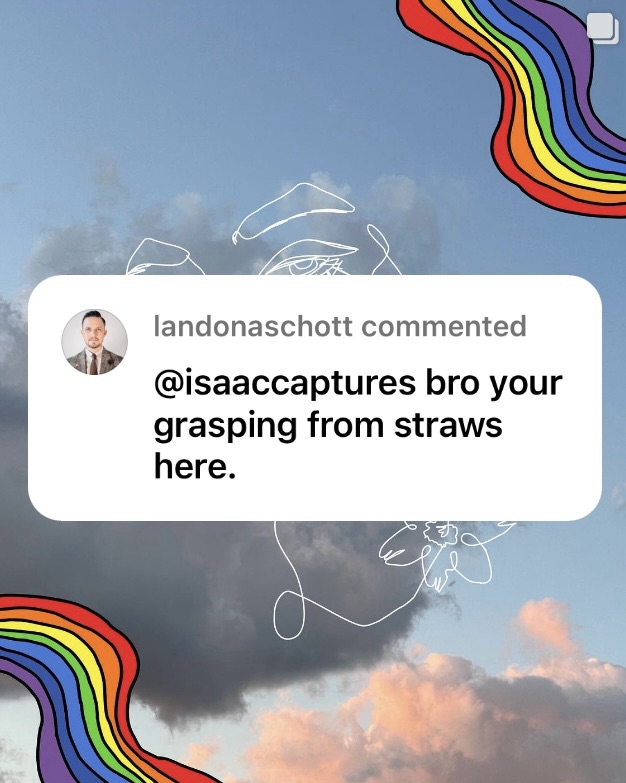
Yesterday Landon Schott commented on a blog post I made a year ago about why I believe that the debate around LGBTQ+ self identification among Christians is frivolous and can result in misrepresentation of the gospel. Here is what happened.
Mega Church lead pastor of multisite church, Mercy Culture Landon posted on his instagram a series of slides going along with his sermon series entitled “abominations”. The first slide had a bold statement without much backing or explanation. “Can you be a gay Christian? No, you cannot!”
Conversations around LGBTQ+ persons who identify as Christians is something I am particularly passionate about, and I am not very fond of wholesale statements that eliminate the possibility of gay people receiving the gift of the gospel (or wholesale discrimination of anyone from being able to follow Jesus for that matter).
I commented on the post asking for further clarification from the pastor,
“What exactly do you propose gay people do who want to be Christian if you state on this instagram post that they cant be a Christian? I don’t really see anywhere in scripture where Christ says that sexual orientation is a barrier to the gospel. In fact, I think the book of Romans has some pretty clear things to say about nothing seperating people from the love of God. I don’t think the cross is nullified because of someone’s attractions.”
Schott responded to my comment by saying
“the same that everyone does. Deny yourself, pick up your cross and follow JESUS!”
Following his response, he went to my account and fond a blog post on the topic and started a debate in the comment section. His initial comment was what I shared yesterday, “No one scripture supports this statement… NOT ONE!”
It is unclear if he has actually read my blog post and just chose not to engage with the interpretation of scripture I proposed, or if he did not actually read the blog post and felt a need to comment because he felt so strongly that I must be wrong.
Landon is no stranger to this controversial topic among Christians. He has gained a following online due in part to his stark criticism of the LGBTQ community and has even written a book entitled “Gay Awareness”
Some of the claims in his book speak to the ethos of his arguments around faith and sexuality.
On page 116 of his book he claims “The ‘gay Christian’ lifestyle aligns better with the Church of Satan’ teachings than biblical teachings of Christianity.” failing to take into account the diversity of “lifestyles” among LGBTQ+ christians. His assertion that all gay people, especially those who self proclaim Christian values are living in overt sexual sin and rejecting biblical teachings of christianity is both reductionistic and ignorant of the experience of many faithful believers who have LGBTQ experiences and in one way or another identify with the queer community.
On page 173, he states “I have not met one individual who self-describes as gay or struggling with SSA who hasn’t been sexually abused or had an absent/distant/strained/abusive relationship with his or her father. This cannot be ignored.” This statement is rooted in the pseudoscience that has been rejected by every major medical and psychology organization as both false, and harmful. I do not want to discredit any one LGBTQ person’s experience with sexual abuse or difficult relationships with parents, but to be frank Landon needs to make friends with more LGBTQ people and he will realize that they are not a monolith. While the data is still unclear and mixed, the origins of sexual orientation are not clear but many people who experience same-sex orientation have great relationships with their parents and have never experienced sexual abuse.
On page 199, he makes the argument that ongoing attractions to the same sex are a sign of potentially millions of demons that have possessed the individual “There is not just one spirit of homosexuality, SSA, immorality, perversion, and more. No person knows how many. But we can give a biblical guess the there are tens of thousands, possibly millions. There are a lot. So when you have the similar temptations or feeling, the devil immediately says, ‘See, you’re not really delivered. You’re still gay. You’ll always be gay.’ The truth is, you were delivered. You defeated that demonic spirit and temptation. . . . There isn’t just one spirit of same-sex temptation or of lust. There are many. The devil wants you to be discouraged by your feelings of temptation when you should be encouraged. God delivered you from the previous temptation. He will deliver you from the next temptation.” Aside from the fact that this is a bit of a stretch theologically, this type of messaging is dangerous because it tells people that things out of their control, like their attractions or sexual orientation, is caused by demonic possession and you simply need another exorcism. I am curious if this messaging also applies to straight Christians? Does he believe he needs an exorcism every time he finds a woman who isn’t his wife attractive? This type of message can lead people to feeling hopeless and depressed, believing they are not loved enough for God to deliver them from their “demons”.
Given his beliefs espoused in his book, it is unsurprising that he would be post unbacked blanketed statements on his social media that seem to suggest that gay people can’t be Christians unless they are somehow delivered of the millions of gay demons possessing their bodies.
I do not understand however, why he would spend his weeknight looking through a twenty-five year old’s instagram and criticizing his blog posts calling for the Church to better love the LGBTQ community without even suggesting they must compromise the historic sexual ethic.
In response to a comment on my post, Landon made a dig at a particular group of people who hold to what is known as “side b theology”. He said “(I am)very familiar with side B. It’s nonsense. We follow Jesus. That’s it. Dedicated Christ followers or pretend Luke-warm.” It is unclear what specifically he takes issue with about the side b community, as they hold to a traditional sexual ethic, believing that marriage is reserved to be between a man and a woman, and that sex outside of that marriage union is prohibited. I asked if he believed there was a faithful way for a gay person to live as a Christian if he even saw those committed to celibacy as “pretend lukewarm” christians. He has yet to respond to this question.
Questions of sexual ethics are important ones, especially in a polarizing society. These questions have been debated in the church in many ways for years, recently to the point of major denominational splits and pain across the globe. The majority of the Christian world, along with the majority of Christian history holds to strict interpretations of sexual morality. Including marriage being between a man and a woman, any sexual activity outside of marriage is forbidden, and that all forms of contraception are prohibited. While the traditional sexual ethic is still the one held by the majority of the Christian world, many denominations and nondenominational churches interpret scripture to allow for variations from the traditional views. It is worth noting that to my knowledge, Landon Schott has not taken a strong stance for or against the use of contraceptives or family planning, while he does believe that scripture is clear on the issue of marriage being between a man and woman.
I fear however, that this is not merely just an issue of sexual ethics for Landon and others like him. To assert that there is no possible way that a certain category of person is able to be a Christian, even if they submit to the ethic you propose, is an exclusionary gospel.
For Landon, the issues seems to be rooted more in homophobia and prejudice than in any real attempts to love and win the LGBTQ community to Christ. If he truly desired for gay people to know Christ, he would offer them hope that God desires them in their entirety. He would not need to compromise a traditional sexual ethic to do so, seeing as many Christians believe that Christmas died for the broken nature of every person’s sexuality, gay or straight. There are many Christians who would claim that gay and lesbian people can in fact be faithful Christians if they chose to be celibate or to enter into mixed orientation marriages. For Landon, it seems that is a “lukewarm” lifestyle and those who are choosing it are “pretend Christians”. I wonder what then he would propose gay people do to live a life for Christ that is not lukewarm.
Seeing as Landon has stopped responding to me, instead he has made further posts responding to “people who are claiming his posts are hate speech”, and has turned off comments. I have tried to message him on instagram but his DM’s are closed, and I could not find an email to him on his church website. I wanted to write this to publicly ask, how does he suppose that someone who is gay follows Christ? Does he believe that someone can only be a Christian if they are delivered from their same-sex attractions? Is this simply a use of language issue? Does a use of a queer-identifying language exclude someone from the gospel? If so, what specifically does he take issue with in my original blog post on queer identification? What are his objections?
Perhaps more pertinent, what does Christ offer sexual minorities and how is the gospel good news for those who’s sexual attractions or experiences with gender seem to be unchanging? If he believes in a traditional sexual ethic, how can gender and sexual minorities thrive as followers of Christ?
If you would like to read the original blog post Landon responded to, or other ones I have written on the topic they are linked below.
Christ said that blessed are those who mourn, for they shall be comforted. I’ve wondered if this was foreshadowing the mourning of his disciples at His crucifixion. I wonder if Mary muttered those words as a prayer after her son was brutally murdered. I wonder if Peter could hear the words echoing as he lamented his betrayal of Jesus right before he was killed.
What delight it must have brought for a gardener to be revealed as the risen Lord. Were the first evangelists of the resurrection experiencing the comfort they had prayed for as they shared the good news with the rest of the disciples?
Blessed are those who mourn, for they will be comforted, by this resurrection or the one to come!
Mourning fits quite nicely with the season of Lent. Death, lament, and repentance seem to surround us from the moment ashes are pressed into our forehead on that solemn and holy Wednesday. As our stomachs growl with hunger and our flesh cries out for relief from the fasting, we are reminded we are merely dust in need of divine mercy. The Eucharist sustains us, a broken body and spilled blood sacrificed for us at regular mass, without it we become ravenous and contentious. Grief fills the air around us, our hearts contrite from sin and our bodies weary from loss.
And then our Lord is hung naked before us. Immediately following him washing our feet and feeding us his body, we deny him, we sell him out and we yell out in anger “Crucify him!” He is whipped in our wrath, his body beaten because of our lust, his head crowned with our shame, his hand pierced because of our unforgiving words.
We dare to watch his side be pierced and weep bitterly. The funeral of our Lord is both celebrated and orchestrated by the very ones who caused his life to end. We remember his hands cleansing our feet. We reflect on his words of kindness and tender kisses. What have we done? What will we do?
Silence and darkness fill the room like a noxious gas slowly stealing our lives.
And then, the unfathomable. He beats death and changes everything. His resurrection seems to cause our words to be echoed back to us, “Crucify Him!” How is it that we could do even this, and he still overcame it? He must truly be the Christ he said he was!
Death is defeated, and because of that, our mourning is not in vain. We find our comfort in this resurgence which restored our Lord and has promised to restore all things to come.
No longer are we bound by the death of this world, but we have an inheritance in the everlasting life of new creation. A new life where creation no longer groans, but delights. A world without sickness, where cancer no longer ravages families. A world where friendships are mended not broken. A world where furry and feathered friends run through fields, and where diverse plans no longer are subjected to harsh GMOs. A world where extinction is reversed and death is no longer needed. A world where the departed are returned to us, and mourning ceases to encapsulate us.
Some of this happens now, by the resurrection that has taken place. Most will happen in the resurrection to come. And perhaps that is what is most beautiful of what Christ accomplished when he rose from the grave. He authored in us something the world needs, a hope for the life to come. A hope that is not dampened by the death of this time, by the destruction of creation, by the loss of loved ones, by broken relationships, and by destitute dreams. This hope offers more to us than any other, for it points us to the day when all will be made right when all will be restored, when dead things come to life, just like the Lord did all those years ago.
He is risen, and one day we will join him. Let us run into easter tide with this hope that goes beyond our human frailties, and bask in the gift of the risen Lord.
On Ash Wednesday this year I felt compelled to make my lenten prayer the Kyrie, a simple prayer that has been prayed by Christians since at least the fifth century.
“Lord, have mercy. Christ have mercy.”
I expected lent to be a long and monotonous season of getting bored of this simple prayer, but I felt the Spirit of God leading me that way so I agreed. I did not expect to be in such gratitude for the crafted prayer the Church has passed down to me.
I had no way of knowing these six little words would have so much to say, that they carried so much weight. They offered me words when the groans grew tired.
When a friendship that was perceived to be beyond repair had to die, leaving broken hearts and empty space in its place.
“Lord, have mercy. Christ have mercy.”
When mental illness began to bear its ugly head, bringing with it horrid memories of the past and fears of the future.
“Lord, have mercy. Christ have mercy.”
When I found myself unable to stop weeping in the car at the news of a friend’s miscarriage, and all that would mean for them.
“Lord, have mercy. Christ have mercy.”
When I heard the news of my mentor’s miscarriage as I felt the kicks of my own child’s feet so rambunctiously causing my wife joyous discomfort inside her womb. Tears blurred my vision, and fear creeping into my mind.
“Lord, have mercy. Christ have mercy.”
When I received a call that I needed to go be with my wife because she was about to find out her dad had a seizure.
“Lord, have mercy. Christ have mercy.”
When she wept in my arms when we discovered he had two tumors on his brain.
“Lord, have mercy. Christ have mercy.”
When we discovered the same day that the family dog had tumors invading her entire body. She would need to be put down before the week was over.
“Lord, have mercy. Christ have mercy.”
When we wondered fearfully if our son would know his granddaddy if they would even meet.
“Lord, have mercy. Christ have mercy.”
When our baby decides to stop kicking and our breath is held for hours, awaiting his movements again.
“Lord, have mercy. Christ have mercy.”
When I offered Clementine her last rites, a practice I am unsure is allowed to be given to animals and one I had no business doing anyway but was the only one around to offer it.
“Lord, have mercy. Christ have mercy.”
When I sat waiting for one parent to recover from brain surgery in an ICU and learned my mother and sister were in a different hospital seven hours away.
“Lord, have mercy. Christ have mercy.”
When I discovered on my birthday that my father-in-law had the worst type of brain cancer you can get, the prognosis hung in the air as if it was attempting to asphyxiate us all.
“Lord, have mercy. Christ have mercy.”
When I was asked to serve the eucharist to the sick, a task I have no business doing but one only I could do in a Catholic hospital where dogma and disunity forbid sacraments mixing.
“Lord, have mercy. Christ have mercy.”
When I had to leave my family to go work, because poverty does not seem to care who is in the hospital and who is healthy.
“Lord, have mercy. Christ have mercy.”
When our family loses jobs and the community suffers.
“Lord, have mercy. Christ have mercy.”
I did not know the power these words would have for me. I had no way of knowing that they would hold with them a million prayers. I could not have known the tears they would accompany or the sorrows they would echo.
Christ hears our prayers, and he does indeed have mercy on us.
His mercy is found in a community that comes to rescue without needing to be asked. It is found in shared laughter that invades the weeping. It is found in sunsets and pink skies. It is found in ladybugs and bluejays. It is found in hospital chapels where holy water answers obscure birthday wishes. It is found in half a dozen friends who clean your home and scrub your baseboards. It is found in venmo gifts from anonymous friends who know that emergencies cost more than you budgeted for. It is found in patron saints who follow you around seemingly more than grief does. It is found in knowing friends, who have gone through similar pains and offer more in a hug than anyone could offer in a thousand words. It is found in street signs, bakeries, and baby books of peculiar names. It is found in the humor of ICU patients. It is found in kind nurses and competent doctors. It is found in the texts from others in pain. It is found in thankfulness for previous pain which offers more wisdom now than you ever could imagine. It is found in album releases and birthday pies. It is found in confessions of weakness. It is found in those who carry God within them in such tangible ways that you know you are not abandoned.
Lord, have mercy. Christ, have mercy. And let the resurrection be right around the corner.
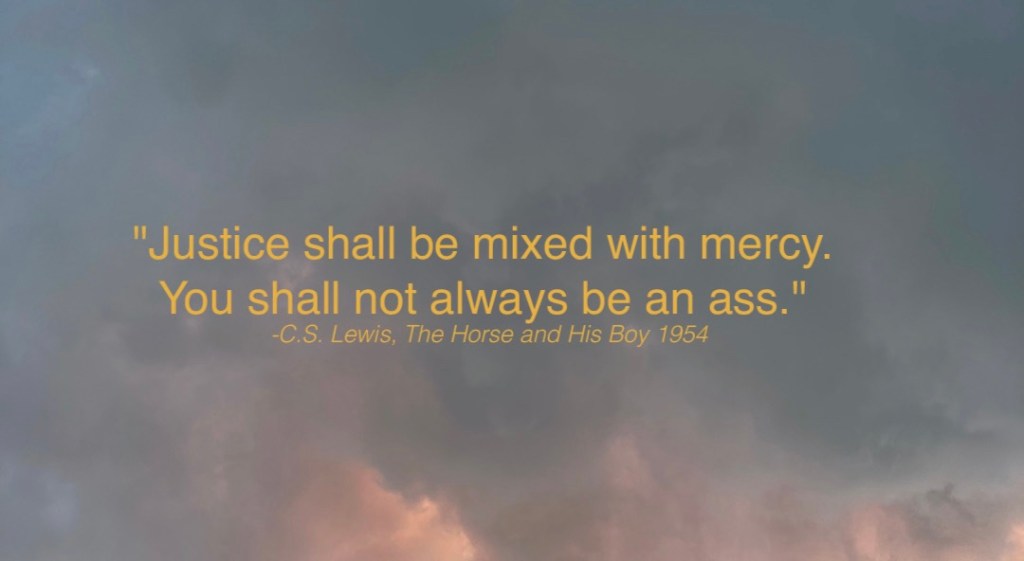
“Justice shall be mixed with mercy. You shall not always be an Ass.” -C.S. Lewis, The Horse and His Boy 1954
Upon capture for his crimes against Narnia, Rabadash was brought in chains to the Kings and Queens of Narnia for judgment. His fate no doubt was deserved, for traitors deserve death. And yet Queen Lucy and King Edmund, in the wisdom that could only be gained through an encounter with Aslan, proposed mercy instead of vengeance. Rabadash in his pride could not hear the mercy being offered by Queens and Kings of honor, for his shame from being caught was too grand and his heart too callous. The warning was not heeded, Aslan himself came to judge and enact justice. A justice that only revealed what was already there, turning a king into an ass, for he already had dishonored himself to the point of folly.
And yet, even in Aslan’s judgment, he remained as merciful as he was just and as kind as he was stern. The king need not remain a donkey all the days of his life, but he would not be allowed to venture off into boundless foolishness as he had before. Aslan’s magic would revert Rabadash to his human form if he stayed within the bounds he should.
What a fickle thing it is, to find ourselves the likes of Rabadash in our own stories. Our own desperation leads us to conquer rather than receive. Our pride blinds us to the feast of grace and mercy before us, illuminating only our shame and fear which ushers us into further destruction. We are no less wicked than a king refusing to hear mercy, no less foolish than a man who has made an ass of himself.
From the dawn of our history, we have made a mockery of the unity we share in Christ. The Church has bickered and grown cold with one another. Saint Paul and Saint Barnabas led the way of the Church in unsightly disagreements leading to broken relationships. The Great Schism and the Reformation led to our current state – the most divided Church in all of history. And still today, our denominations are splitting one after another. Methodists, Baptists, Anglicans, Lutherans. We seem to only see the things which separate us, and forget the things which unite us.
Our sins go further than denominational divides. We are abusers and liars. We seek control and comfort. Our pride leads us to believe we can accomplish peace without love. We fail to be honest and fail to be kind. The wounds of our messiness become irreparable and turn our laughter into tears. Brothers are separated, and friendships are forced to die.
And yet, justice mixes with mercy. We are destined perhaps to transform into the very things we mock but by God’s grace, we are not left to be a beast forever.
It is perhaps justice, that the church remains in pain from our division. We have become so prideful as to preclude others from sharing in the Lord’s table. We have forced one another into becoming the enemy. Each side in turn is the schismatic brethren, neither is without faults. And therefore we each claim the Lord is on our side, that he is in, or present with our eucharist. We are revilers of our family, spitting curses and screaming heresy without remorse. We fail to see the need for each other, and we grow colder because of it. In attempts to claim one virtue more valuable than another, we lose our righteousness altogether. We have truly made fools of ourselves, transforming into asses in the process.
Yet this justice mixes with mercy. We shall not always be an ass. Mercy trickles through our divisions like light through stained glass windows. God’s graces are demonstrated through the outstretched arms of brotherhood. Through shared prayers and repeated confessions. Mercy is felt through the waters of baptism, which extend beyond any denominational split or imprudent words. The trickle of holy water on foreheads reminds us all, we are born of the same womb. The sign of the cross marks us siblings of high importance. Mercy is seen even in our donkey state, in the blessings we offer each other instead of blood and body. Our arms are crossed in stubbornness, while our spirits crave the prayers of the righteous.
As Rabadash upon his purification was bound to his town, we are perhaps bound to our tribes. On good days we are called Rabadash the peacemaker, but everyone knows we are truly Rabadash the Ridiculous, for the mockery of our disunity can not be forgotten by the world.
Justice mixes with mercy, and we remember our hope is not in this life but in the one to come. The eschaton that will bring ultimate unity, wash away all senseless disagreements, and heal all our wounds. Holy waters remind us that the kingdom is already and not yet. As priests splash our feeble bodies, we are united, awaiting the days when we can swim in the waters that only splash our skin.
I am a firm believer in the importance of precise language. I have seen time and time again Christians fall into divisions, disunity, and outright chastisement of each other because of confusion around the use of language. This issue of language is perhaps most prevalent in Christian conversations around LGBTQ+ issues.
Over my 24+ years in Church, I have witnessed arguments of language dominate conversations around faith and sexuality. As a result of this absolutism, I believe the Church has missed a vital opportunity to minister and disciple entire populations of the Church. In this blog, I want to make a case for why we should stop policing Christians’ use of terms such as “gay Christian”, and how that can perhaps actually lead to greater discipleship and clarity around what a Christian sexual ethic can actually look like. I know I may have already caused some of you to cringe, get angry, or be skeptical. I realize many of you probably clicked on this post purely to argue against its provocative title, or because you wanted to read for yourself how I have “lost my way”. I hope and pray that you will stick around to read the entire post before making any rash judgments.
The Merriam-Webster dictionary would define ‘gay‘ and similarly ‘queer’ as “of, relating to, or characterized by sexual or romantic attraction to people of one’s same sex”, a definition which could be simplified to mean “a male who is attracted to other males or a female who is attracted to other females”.
If you asked any pastor in the Western world, “Could someone who experiences attraction to the same sex still be a Christian?” you would in most cases receive an enthusiastic “Yes!”. In every Christian tradition throughout all of the Church’s history Christianity has never required any lack of sexual or romantic attraction towards the same sex or otherwise. Why then have many in the church, including entire denominations, claimed that to identify as a “gay Christian” is inconsistent with a Christian witness?
If you do not have experience in the evangelical church this concept may be completely foreign to you. As most of the secular Western world sees it, identifying as queer is comparable to any other identifier such as Hispanic, disabled, father, wife, etc. Meaning, that being part of the LGBTQ+ community should have no more to do with your ability to be a Christian than being a part of a particular ethnic group or even being straight for that matter. In recent years in much of the Western Church, however, identifying as gay has often been criticized as being incompatible with the Christian faith.
This phenomenon is a rather recent argument made by people within the Church. As late as 1975, leaders like Billy Graham publicly backed ordaining gay Christians. He said as much in an article in the Atlanta Journal-Constitution titled, “Billy Graham Backs Ordaining Homosexuals”. He was asked by a journalist if he would support the ordination of a gay man to the Christian ministry, and he replied by speaking to the character of the man rather than his sexual orientation. He went on to say that requirements for Christian ministry rather than identifying as heterosexual were “turning away from their sins, receiving Christ, offering themselves to Christ and the ministry after repentance, and obtaining the proper training for the job.” 1
John Stott advocated for a distinction between how Christians viewed sexual orientation and sexual ethics in a 1978 sermon, later collected in a book titled, Issues Facing Christians Today. He argued that sexual orientation is generally unchosen and relatively fixed, saying, “We may not blame people for what they are, though we may for what they do,” He went on to say, “In every discussion about homosexuality we must be rigorous in differentiating between this ‘being’ and ‘doing’, that is, between a person’s identity and activity, sexual preference and sexual practice, constitution, and conduct.”2
Many other Christian leaders spoke fondly of the gay community, all without compromising on their tradition’s view of a Christian sex ethic. C.S. Lewis spoke of one gay man as his ‘oldest and most intimate friend” 3. Francis Schaeffer along with many other evangelicals at the time opposed the ordination of sexually active queer men and women, yet made a clear distinction between someone’s orientation, and their sexual practices and ethics. He stated in a 1968 letter to a European pastor, “By definition, to be a homophile (a gay person) is a person who is born so that they have a natural tendency toward affection and sexual practice with their own sex… Not all homophiles practice homosexuality and not all who practice homosexuality were born homophiles.” 4
It wasn’t until the 1990s that an alternative way of discussing Christians who experienced attraction to the same sex was birthed. To this day, many Christians argue that the only faithful way of discussing or describing their experience of homosexuality is by identifying as “Same-Sex Attracted”, or in some cases simply saying they struggle or wrestle with same-sex attraction. Entire denominations put out statements implying this to be the only orthodox way of describing the queer experience while adhering to a historic Christian sexual ethic. 5
Given the intensity with which Western Christians seem to back the language of “same-sex attraction” over other queer identification, it may come to be a surprise that this description of people with a queer sexual/romantic orientation was not created by Christians at all. The first time we see any use of the term “same-sex attraction” was in the early 1980s used by secular sex researchers in clinical literature.6 Following its appearance in clinical sex research, secular therapists used the term as a means of conversion therapy. It wasn’t until 1994 that any reference to “same-sex attraction” appeared in religious circles. In the Mormon book titled Born That Way? A True Story of Overcoming Same-Sex Attraction, Erin Eldridge used the term in a nonclinical way within the context of an ex-gay conversion ministry a part of Mormonism.7 Three years later, Garrick and Ginger Hyde would publish a book titled A Place in the Kingdom: Spiritual Insights from Latter-day Saints about Same-Sex Attraction that used the language of “struggling with same-sex attraction” as a means of furthering the ex-gay movement known for harmful conversion therapy practices.8 It was not until the early 2000s that Protestants began to appropriate the term coined by secular sex researchers and popularized by Mormons promoting conversion therapy. Many of the early protestant uses of the phrase were linked to conversion therapeutic practices and ex-gay ministries.9 Most of these ministries were later discredited after it came out that attempts at sexual orientation changes were nearly entirely ineffective.10
The surprising roots of the term “same-sex attracted” have not kept it from becoming the main phrase many evangelicals demand people use in order to be accepted into churches and denominations. This fact is surprising given the evangelical tendency to shy away from the use of practices rooted in secular or non-Christian ideology. This form of gatekeeping is often a main source of tension between the queer community and the evangelical church. While various traditions and denominations hold to various interpretations of the Christian sexual ethic, the policing of language seems to be the center of most debates surrounding the queer community and Christian faith. According to Andrew Martin, 76% of LGBTQ+ people who have left the Christian faith are open to returning, a jarring jump from just 9% of the general population.11 For many in the LGBTQ+ community, leaving a church or even the faith entirely had little to do with an unwillingness to participate in the tradition’s sexual ethics. Instead many leave as a result of being discriminated against for their attractions, orientation, or the way in which they identify or act outside of sexual activity.12
Seeing that disagreements around sexual ethics seem to be less pressing for those who are leaving the Church in droves, the question arises why churches and individuals would hold so tightly to these sex researchers, conversion therapists, or perhaps generously, Mormon terms of sexuality. Without addressing the Church of Latter-day Saints further, which to this day has a statement forbidding queer identification13, many Protestant Christians still prefer the “same-sex attraction” terminology. Many even argue that to identify as lesbian, gay, bisexual, transgender, queer, etc. is antithetical to the Christian witness. That it is placing identity in sin rather than in Christ14. There are several major issues with this interpretation.
Identifying as queer does not inherently mean identifying with sin. While the debate has been growing in recent years on whether the historic interpretation of scripture is an accurate and helpful one for a modern Christian sex ethic, identification within the queer community is not synonymous with a particular sexual ethic or activity. As previously noted, for most of the Christian world prior to the infamous “ex-gay movement”, referring to sexual orientation had no moral value apart from a further statement about one’s sexual activity. Furthermore, apart from some Christian circles, most people follow the plain definitions of gay, lesbian, and queer. Put simply, to be gay is simply to be someone attracted to the same sex as you, which in most of Western secular culture holds no moral weight or particular sexual ethic.
To insist that identifying as queer means one is renouncing the Christian faith is inconsistent with the Church’s general stance on other so-called “identification with sin”. There seems to be no substantial pushback on the rather successful program for those battling alcohol addiction. Alcoholics Anonymous, originally started by Christian influence, is known widely for its first step to recovery: admitting you are an alcoholic.15 Churches across the world have historically partnered with and participated in Alcoholics Anonymous. This seems to contradict the assertion that not identifying with sin is essential to the Christian faith.
The assertion that someone cannot identify with a so-called sin, is also inconsistent with scripture. Listed among the Hall of Faith in Hebrews 11, is “Rahab the prostitute”. Even if the identification as queer held inherent sexual deviance that was seen as sinful in a Christian sexual ethic, we can clearly see that identification with one’s sexual deviance does not exclude someone from the kingdom of God. In fact, Rahab’s listing among the other heroes of faith is perhaps a clear indication that one’s identification with a marginalized group associated with sexual defiance can be a witness to the world of the redeeming power of Christ. Perhaps the queer-identifying Christian, like Rahab, can be a symbol of the gospel, which does not require more than faith and allegiance to Christ. Perhaps the identity of a sexual minority does negate the title of faithful one.
Seeing beyond even this debate, one could point out the faults in teachings on “identity”. The prominent message of “identity in Christ” is a rather new concept. In fact, upon searching for Christian teachings on “placing identity in Christ” it is nearly impossible to find any relative messages prior to the 1980s.16 This is in large part due to the rise of the self-focus that the late 1900s brought to the Western world.
Arguments made that we must place our “identity” in Christ often carried the negative side effect of undermining other identities given to us through scripture by God, such as that of sons, daughters, mothers, and fathers. While scripture lifts up the specific and important roles that various members of a family hold, arguments that our identity should be in Christ alone seem antithetical to the emphasis placed on particular identities within the family of God. Additionally, to make the argument that one is not part of a particular nationality is to negate the specific time and boundaries which God created for that person to reside in (Acts 17:26).
Alternatively, teaching union with Christ (Colossians 3:3-4) offers a far more theologically robust contemplation of the Christian life. Union with Christ does not require that we set aside the other identities we hold, but rather that they be joined with him. The Gentiles did not forgo their ethnic identity but rather were unified with Christ in their Gentile identity. In fact, the highlighting of the difference between Jew and Gentile was perhaps critical to the furthering of the gospel and the growth of the early Church. Rahab need not shed the title of a prostitute, for her union with God through her faith placed her within the kingdom of God. Union with Christ supposes a far greater truth for us, that when we become in Christ when we are baptized into this faith, we are unified with him. This truth proclaims good news for all; for Rahab, who was unified with Christ even carrying the identity of a prostitute, for the mother who is unified with Christ yet does not lose her motherhood distinction, and her God-given calling as a mother, and for the queer woman who has been attracted to women her whole life, yet comes under the Lordship of Christ. If you desire to learn more about the distinction between identity in Christ and union with him, Caleb Morell offers fantastic insight in his article, Stop Finding Your Identity in Christ.17
Some may beg the question, why is identifying as queer important? People may carry a variety of personal reasons, but perhaps the most important of reasons someone may give is also the most jarring one. According to the Injury Control Research Center at West Virginia University in Morgantown, research has shown that queer people who stay in Church are 30-55% more likely to die by suicide if they stay within the Church than if they leave.18 Notably, in other studies of every population besides those who identify as LGBTQ+, suicide risk decreases with Church involvement.19 For many, being told they cannot be a gay Christian is interpreted as them being deemed ineligible to receive the free gift of eternal life. For many young people whose homosexual orientation seems to be relatively fixed, (that is in most cases) being told they cannot be queer and Christian is analogous to being told they cannot be a Christian. There seems to be no hope offered for those who wish to follow Christ, but cannot seem to see substantial change in their orientation.
Language is of vital importance in this conversation, because if we are not precise with our language, we are effectively teaching a false gospel, one that excludes the marginalized, and ostracizes the sexual minority. While different traditions and denominations have varying interpretations of what the Christian sexual ethic entails, to assert that one cannot be gay and Christian is to preach an exclusionary gospel. It may be entirely possible to welcome and support many queer Christians, without changing the Christian sexual ethic upheld in your tradition. In fact, many LGBTQ+ identifying Christians desire to be included and wanted within various traditions with more conservative sexual ethics. For those desiring to submit to a traditional Christian sexual ethic, having space for queer identification could be the difference between someone staying faithful throughout their life, or walking away due to a false understanding of the gospel.
If you desire to learn more about the history of queer identification within the Christian tradition, the scandal of the ex-gay movement, or following a historic Christian sexual ethic as a sexual minority I recommend the following resources:
Still Time To Care: What We Can Learn from the Churches Failed Attempt to Cure Homosexuality By Greg JohnsonPeople To Be Loved: Why Homosexuality is not Just an Issue By Preston SprinkleNetflix’s “Pray Away”: Beware of False Dichotomies By Pieter Valk (Originally published by The Center for Faith, Sexuality, and Gender)
Side B Christians Like Me Are An Asset Not a Threat By Bekah Mason (Originally published by Christianity Today)
Sources:
1: UPI, “Billy Graham Backs Ordaining Homosexuals,” Atlanta Journal Constitution, July 25,1975, 21.
2: Stott, Issues Facing Christians Today, 303.
3: C.S. Lewis, Surprised by Joy (New York: Houghton Mifflin Harcourt, 1956), 97.
4: Francis A. Schaeffer, Letters of Francis Schaeffer (Westchester, IL: Crossway, 1985), 193-95.
6: A 2021 Google n-gram search of the phrase “same-sex attraction” showed almost no use of the term in volumes within Google Books before 1981.
7:Erin Eldridge, Born This Way? A True Story of Overcoming Same-Sex Attraction (Salt Lake City: Deseret, 1994).
8:Garrick Hyde and Ginger Hyde, A Place in the Kingdom: Spiritual Insights from Latter-day Saints about Same-Sex Attraction (Salt Lake City: Century,1997).
9:Richard Cohen, Coming Out Straight (Oakhill Press, 2001).
11:Marin, Andrew P. US versus us: The untold story of religion and the LGBT community. Colorado Springs: NavPress, 2016.
12:Woodell, Brandi, and Philip Schwadel. 2020. “Changes in Religiosity among Lesbian, Gay, and Bisexual Emerging Adults.” Journal for the Scientific Study of Religion 59 (2): 379–96. https://doi.org/10.1111/jssr.12653.
3 responses to “A Case for Queer Identification among Christians”
Mateo
Question concerning the concept of identity: How would you interpret “a renewal in which there is no distinction between Greek and Jew, circumcised and uncircumcised, barbarian, Scythian, slave and freeman, but Christ is all, and in all.”
Colossians 3:11 NASB1995
When specifically discussing Gentile and Jewish identity, I think looking at the context of scripture is important. I tend to lean more towards the interpretation that “Jew nor Gentile” does not negate the realities of culture, but is rather promoting a diversity within body of Christ. We are all one in Christ, yet bring with us differences or ‘identities’.
This was one of the major problems within the early Church, Jews and Gentiles attempting to discern what needed to change for participation within Christianity. Some wanted men to be required to circumcised, but Paul addressed that clearly. Circumcision was no longer a requirement of holiness, but a mark of Jewish culture and identity.
This article I believe does a good job to getting into the particulars of interpretation and exegesis more than I am qualified to speak to. I found it helpful for thinking through this discussion. I recommend giving it a read for a more in depth answer from a more qualified thinker.
In terms of how this might apply to sexual orientation as identity, I believe the comparison is a reasonable one. Gentile converts were at the center of controversy because for Jewish people, the very idea of a Gentile seemed synonymous with sin. We see however, that the gospel broke past that barrier and made a way for Jew and Gentile to both inherit the kingdom of God. Gentiles were not forced to become Jews to be one with Christ, rather Jew and Gentile alike were made one with Christ through faith. I would make the argument that in the same way, there is neither gay Christian nor straight Christian (opposite-sex attracted Christian, nor same-sex attracted Christian) but Christ is all, and in all.
Just as Gentile and Jew must submit their lives, allegiance, and obedience of Christ, so do both straight and gay people. Just as the Jew and Gentile must surrender their lives, so also do gay people and straight people (which includes the brokenness in everyone’s sexuality) to Christ’s Lordship.
her vail washed with his blood as her train is stained with evil’s corruption
how might we muster the courage to stand with the saints, while our faith is lampooned
where is our Lord, as injustice claims his name and revolution is sidelined?
and yet, the saints sing and hope flows from weary eyes
From weary eyes, hope flows | Isaac Overton
I’ve had a peculiar relationship with Christ’s bride lately. In the reckoning of various personal experiences of abuse and mistreatment from those who claim Christ, I have spent the last few years in search of something more. A search for the so-called “ecclesia” spoken of in the book of acts and seemingly abandoned in modern western civilization.
And I have no doubt found it.
I have found it in communion, in the holy eucharist that somehow equalizes us all with its mystical presence.
I have found it in inter-denominational worship services. Through ecumenical practices that somehow bring together people with vastly differing theology under the banner of Christ.
I have found it in the prophets of old, calling out injustice through absurd yet righteous protests. In voices like Amos and Malachi, in the cries of Jeremiah and Micah, in the absurdities of Isaiah’s disruptive nudity, and in Ezekiel’s 390-day demonstration of Israel’s sin.
I have found it in modern prophets, whose voices echo that of scripture. In Shane Claiborne’s call for a divorce of the Bride and the Empire. In Tish Harrison Warren’s call for a return to the ordinary and the embrace of liturgical practice. In Jackie Hill Perry’s call to deeper holiness, for God himself is holy. In Jemar Tisby’s call for a church whose gospel is not one of oppression, but of justice. And in Preston Sprinkle’s call for a theology of nuance and excellence.
I have found it through traditions different than my own. In the Anglican’s careful attention to Church tradition and steadfastness amidst cultural swirling. In the Catholic’s reverence for communion and practice of confession. In the Anabaptist’s unwavering nonviolence, and dedication to ecclesiastical purity in the midst of violent empires.
I found it on Thursday nights in my small apartment. Where we practice a faith that has been laid before us for centuries. Where we gather around the table and join in sorrowful woes and joyous celebrations all as we look to a man whose life was broken for our feasting.
Yet, just as I have found the beauty of the bride my savior so cherishes, I have also seen more of her wickedness. So my heart swells with both joys and sorrows. For I know the beauty the bride holds, yet I see all too often she wears imposters clothes. Her splendor is shrouded by wickedness. I live in a tension of here and not yet, and I think there is a holiness found in that. So although my eyes may be weary, hope flows from them as I hear the saints sing.
It is with great grief that I begin to write about such a topic. As I assume it might be with a heavy heart that any believer might feel as they reflect on injustice and pain inflicted in the name of Christ. But just as it pains me, it also reminds me that perhaps the true mark of the Christian is their ability to repent, turning even from their most grievous sins. And perhaps it is in our repentance and our forgiveness that we can better demonstrate the power of such a great sacrifice that was given to us through the bleeding hands and sweating brows of our Lord Jesus.
Let me start by stating that this is not a post to debate any theology regarding whether or not a particular sexual relationship is sinful. Nor is it a discussion of the legitimacy or lack thereof, of sex change under the circumstance of gender dysphoria. For one, I believe that conversation too often derails Christians from the needed work of loving our neighbor. Sadly most debates around these issues have far less to do with what scripture says and more to do with individual experiences, interpretation of those experiences, and how to live faithfully in light of conviction and devotion to Christ. As far as I am concerned, for those who claim the name of Christ, the deep and personal decisions of sexual stewardship are better worked out through discipleship, guidance and when necessary, the discipline of the local faith community to which the particular believer belongs. And as we are encouraged throughout scripture, it is not up to the church to judge those who are outside on their morality, but rather is a right given to God. (1 Corinthians 5:12-13) Furthermore, I think any conversation about the complexities of faith and sexuality is better suited in a face-to-face discussion, not as an aside to a different point. Perhaps in the future, I will offer a more detailed look into where I stand theologically on such topics, but for now, I would like to focus not on the queer community themselves, but on our posture towards them.
The belief commonly known as a traditional Christian sexual ethic has turned from a highly esteemed value to an excuse for bigotry and pride-filled judgment. The historic Christian sexual ethic can be summed up as the belief that God created humankind, male and female in his own image and likeness and that through scripture God has revealed his design for marriage and human sexuality. Marriage is then, ordained by God as a lifelong, covenantal union between a man and a woman, and sexual intimacy is to be enjoyed exclusively between a husband and wife, and any expression outside of that would be out of God’s creational design. It is no secret that the dissonance between the Church and the LGBTQ+ community has only seemed to grow over the last few decades, but what many congregations seem to fail to understand is why that is. Some seem to ignore this growing distaste from queer people as a media trend, while others simply write it off as a ‘sin’ of the queer community to hate the Church. Unfortunately, history is far more haunting than Hollywood’s distrust of Christianity or some communal sin of gay activists.
It is through our reflection on the past that we can perhaps gain a glimpse into the explanations for our current relationships with the queer community. It is common knowledge that the Church does not stand on good terms with those who identify as LGBTQ+, despite some research1 suggesting that nearly half of all LGBTQ+ people consider themselves to be religious in some way. For much of the queer community, distrusts and hurt has not come on the part of Christ, but from his Church.
One particularly woeful response of the American Church was our response to the AIDS crisis. While the AIDS crisis claimed the lives of well over 100,000 Americans in the 80s alone, Christians seldom offered any attempt of help or even offer expressions of grief. 2,3While the secular world funded medical research, provided social assistance, and offered hospice care for those affected by AIDS, the Church was at best silent, and at its worse hateful. These actions were a result of a belief held by many, that the AIDS epidemic was God’s judgment on the gay community. This was further exacerbated by Christian leaders the likes of Billy Graham making public statements asserting that those affected by AIDS were most likely affected on account of the judgment of God. These statements only further justified the lay Christian’s disdain for the queer community and gave way to a lack of empathy or calls for Christian love. 4
While the evangelical church has no shortage of penance to pay for its sins against our queer brothers and sisters, perhaps among our greatest failures is the Exodus International movement, commonly known as the “Ex-Gay” movement.
Exodus International was founded in 1976 and was actively running for 37 years before being shut down by its President and Board in 2013. Exodus was a self-described “Ex-Gay” Christian ministry, aimed at helping queer Christians who desired to limit their homosexual attraction. Over its many years in operation, the ministry boasted of its ability to lessen and even eliminate same-sex attraction among those who faithfully committed to the programs. Many queer individuals who subscribed to Exodus’s methods would marry someone of the opposite sex, have children, and even join the staff of the organization.
Over its course, Exodus International had impacted the lives of hundreds of thousands of people, making promises that homosexual desires could be cured. Since its closure, nearly every person who went through the ministry has reported little to no long-term change in sexual orientation, many of whom have since left the Christian faith and some have even made attempts at suicide as a result of their experiences in the ministry. As a result of promises of change not being fulfilled, entire generations of queer people have gained a distaste for any semblance of input from the Church into conversations of queer idenity or sexual stewardship.5
Upon the closure of Exodus International, Alan Chambers the ministry President stated, “For quite some time, we’ve been imprisoned in a worldview that’s neither honoring toward our fellow human beings nor biblical.” Chambers himself identified as gay, and upon going through the ministry married a woman and had several children. He now admits he has ongoing attractions to men and was hiding his attractions in an attempt to appear legitimate. Although at the time of the ministry’s disbandment, he still held a historical Christian sexual ethic, he no longer saw efforts towards orientation change to be a viable option. He went on to say, “It is strange to be someone who has both been hurt by the Church’s treatment of the LGBTQ community, and also to be someone who must apologize for being part of the very system of ignorance that perpetuated that hurt.” 6
Alan Chambers was not the only staff member to come out against the methods and practices of Exodus International. Many former leaders have since come forth with formal apologies. Jeremy Marks stated in an apology, “Though at the time we did not see it this way, our collusion involved setting up and maintaining an oppressive anti-gay, and I must also say equally anti-Christian view of homosexuality, that profoundly dishonors Jesus Christ and has betrayed the Gospel.” Marks was the President of Exodus’ Europe division, and over time became particularly concerned with the ways in which Exodus International’s efforts towards orientation change continued to perpetuate long-term detrimental effects, such as loss of faith, broken marriages, and suicide attempts. In an effort to correct his errors, Marks shifted his particular ministry to a gay-affirming organization known as “Courage UK”. 7
Micheal Bussee was also known for his prominence in Exodus. Bussee, along with Gary Cooper were known for their departure, when they publicly declared their love for one another and left to be together. Bussee was later quoted discussing his experience of Exodus saying, “I needed to believe that I was now heterosexual – to “name it and claim it.” God would do the miracle over time. “Keep praying,” they told me. If I had enough faith, I would eventually be “set free.” I wanted it more than anything and sincerely believed it would come true.” During his time at Exodus, Bussee established his own branch which he called E.X.I.T. which stood for EX-gay Intervention Team. He continued to teach that if queer people prayed hard enough, and claimed it to be true, God would eventually grant them the orientation change they desired. Pastors and therapists from across the nation began to send those experiencing same-sex attraction to Bussee for ministry to help people “exit” their gay orientation.8
While many leaders such as Marks and Bussee left Exodus to become affirming, not every leader felt leaving the Christian traditional sexual ethic was in alignment with their convictions or faith. Nate Collins was among many who felt, that although Exodus failed to represent Christ, the Church’s stance on sexual ethics was a worthy pursuit. Upon the announcement of Exodus’s disbandment, Collins was among the last to publicly speak at Exodus’ final conference, which was shaped around repentance and confronting the atrocious acts of the movement. Collins famously shared a story at that conference about his own suffering within the movement, only to boast of Christ’s ability to redeem even the most gruesome tribulations for good. In the weeks following the closing of Exodus International, Collins reflected on his lament of both Exodus’s heinous actions and the reality that in some ways it was a safer place than most congregations. “Exodus International certainly represented a much safer place than the vast majority of churches for Christians to be transparent about their experiences with same-sex attraction. But it nonetheless did so within the context of a triumphalist church subculture that often preferred ‘finished product’ Christians to ‘in-process’ Christians.”9
Collins has since gone on to found Revoice, a ministry for LGBTQ Christians who while adhering to a traditional Christian sexual ethic, do not believe there is any orientation change required to be a faithful Christian. Revoice has ministered to thousands of Christians who experience same-sex attraction, and/or identify as LGBTQ+, as well as partnered with churches to support and create safe places for queer people. Revoice now offers community groups, a yearly conference, and partners with several other ministries that make efforts towards healing the relationship between the LGBTQ+ community and the Church.10
While the AIDS crisis is over, Billy Graham passed away in 2018, and Exodus International has been disbanded for many years, it is no doubt that the rhetoric, often left unrepented, has continued to play part in the passing down of false and abusive uses of God’s name. There are still many ministries alive and active that were once affiliated with Exodus International.11 And many Christian leaders still make attempts to assert both intentionally and unintentionally that LGBTQ people are somehow worthy of death in some exclusive and divine way. We see the threads of this rhetoric prevailing today through outlandish assertions from the likes of Pastor Dillon Awe, who said that queer people should be “lined up against the wall and shot in the back of the head” from the pulpit, claiming “that’s what God teaches”,12 as well as the intentional and unintentional misuse of scripture to justify violence.
One common misguided teaching prominent in churches today is the preaching of Romans 1 out of context. Often quoted to prove a point, it has become common practice to quote Romans 1:26-27, and verse 32 which would read “For this reason, God delivered them over to disgraceful passions. Their women exchanged natural sexual relations for unnatural ones.The men in the same way also left natural relations with women and were inflamed in their lust for one another. Men committed shameless acts with men and received in their own persons the appropriate penalty for their error. Although they know God’s just sentence—that those who practice such things deserve to die—they not only do them but even applaud others who practice them.” While this is not inserting scripture not true to the text, it is an intentional avoidance of verses 28-31, which go on to list many other actions deemed “deserving of death” by the author. “And because they did not think it worthwhile to acknowledge God, God delivered them over to a corrupt mind so that they do what is not right. They are filled with all unrighteousness evil, greed, and wickedness. They are full of envy, murder, quarrels, deceit, and malice. They are gossips,slanderers, God-haters, arrogant, proud, boastful, inventors of evil, disobedient to parents, senseless, untrustworthy, unloving, and unmerciful.” This overt omission often leads people to believe queer individuals are somehow more deserving of death than the rest of the world. While for some this may lead to assertions that queer individuals are deserving of death for their queerness, others can jump to conclusions like that of Pastor Awe, claiming that God teaches believers to insight violence against the LGBTQ+ community.
Perhaps even more concerning, in relation to poor exegesis is the ignorance of the rest of Paul’s letter to the Romans, which offers insight into the phrase “those who practice such things deserve to die”. Romans 2 offers a very important reminder in light of Paul’s seemingly combative statements in chapter 1. “Therefore, every one of you who judges is without excuse. For when you judge another, you condemn yourself, since you, the judge, do the same things.” Paul later goes on to say, “Do you think—anyone of you who judges those who do such things yet does the same—that you will escape God’s judgment?” and “For there is no favoritism with God.” It is through the lens of our depravity, that we must read the scriptures, looking first inwards in self-examination and repentance.
It is through the rest of Romans, that we find hope both for ourselves and for the world around us. Romans 3:23-25 “The righteousness of God is through faith in Jesus Christ to all who believe, since there is no distinction.For all have sinned and fall short of the glory of God;they are justified freely by his grace through the redemption that is in Christ Jesus.” Further on Paul pulls from his concept of being deserving of death in Romans 6:23 “For the wages of sin is death, but the gift of God is eternal life in Christ Jesus our Lord.” While some may point to Paul’s letter to the Romans to justify their fear and detests for the queer community, they fail to see the gifts offered in this sacred text, instead appropriating it for their own self-righteous pursuits. This failure to read Romans 1 in its proper context is not only a failure to the queer community, but to every believer or unbeliever, for it attempts to negate the offering of eternal life that is the gift of God.
I do not try to suppose that it is simply the Christian ethic itself that is the problem. The Church’s sexual ethics have had success being applied throughout all of church history without the inclusion of prejudice or abuse. C.S. Lewis is known as one of the greatest Christian leaders of the last century. Although Lewis never shied from admitting his views on Christian sexual ethics, he reportedly was intentional in not condemning others for their attractions or orientation and actively spoke against homophobia and the judgment of the queer community. Lewis was known for his friendship with Arthur Greeves, who was gay. He was intentional in his efforts to never speak poorly of Arthur, but only with high esteem. Often in writing, Lewis would speak of his own bend towards taboo sexual desires in juxtaposition to his discussions of homosexuality.13
Lewis often spoke of homosexuality with a humility that offered hope and honor to his gay friends. He frequently spent time addressing other things he deemed more egregious sins such as jealousy. Lewis often admitted he did not know with certainty why his queer friends faced such tribulations but encouraged them that as in all tribulations, it must be offered to God in faith that he would make all things good for those who loved him.14
While we cannot undo the harm done in the wake of the AIDS crisis, or in the wake of everything that the Ex-Gay movement has and still is perpetuating, we can ask for forgiveness, and we can repent of our own sins. I believe it is perhaps the most Christian thing to do, to seek forgiveness and reconciliation, both with God and with his children. What better acknowledgment of Christ’s sacrifice, than to admit our failures, and to move towards healing?
In the midst of outrage and debate over the supposed sins of the gay community, we have failed to acknowledge the sins of homophobia rampant in our culture, our churches, and our hearts. In our attempts to change orientations, we have neglected to love. Through our brawl with the queer community, we have forgotten the essential truth; Jesus died for the LGBTQ+ community too, not so that they can be made straight, or cisgender, but because he loved them just as they are.
My dearest brothers and sisters, in the midst of our tears and joys, I implore you to allow the Spirit to lead you once again. We have a choice on this historic day; will we stay celebrating only to abandon a great and holy call, or will we be quick to listen to the God who cares more about life than any of us? As the news begins to swarm about the overturning of Roe v. Wade and many mixed emotions begin to fill our streets and pews we have a choice to make. Will we be known as the Church that overwhelmed an already exploding foster care system, or the Church that took responsibility for not only the overturning of Roe v. Wade but the resulting catastrophic effects of removing a woman’s ability to terminate a pregnancy? Will we be as the historic church was, a people who stand in the gaps of governmental systems and infrastructure failures?
Evangelical Christians have been at the center of the issue of abortion since the early ’80s when President Ronald Reagan began to mobilize evangelicals to use their voices to elect him. (1) According to one conservative Evangelical group, it is estimated that $55 billion dollars have been raised to fight Roe V. Wade in less than a twenty-year span between 2000 and 2019. (2) For perspective, that is nearly 15 times more than both the republican and democrat parties raised during the 2020 presidential election. (3) The question is at hand then where can the pro-life movement go next? While many will stay faithful to the end, seeking to outlaw abortion in every individual state, some see the supreme court’s decision as victory enough.
The values of the pro-life movement are conducive to an easy switch from fighting abortion to a number of other causes revolving around the sanctity of life. I would like to offer some suggestions for which to pour our energy, time, finances, and even voting power toward goals that would align beautifully with the preserving and protecting of life.
Perhaps an obvious first response would be to support those affected most by the outlawing of abortion in various states, both mothers and babies. Support for mothers should be at the forefront of every follower of Christ, especially those who have advocated for their pregnancies to be kept to term. For most women seeking an abortion, it is a last resort or seen as a necessity for not only their lives but for fear of the baby having a life filled with hardship. If political change is something you are passionate about, perhaps your advocacy to end abortion can be shifted toward seeking policy change that would provide resources and assistance for single mothers, such as affordable health care, discounted or free childcare, increased financial assistance, and mandatory maternal and paternal leave.
Families Valued is an initiative of the Center for Public Justice, it is a non-partisan, Christian organization seeking policy reform that protects religious liberty while seeking welfare reform and seeks to close the opportunity gap through political advocacy.
If more personal action is what you are passionate about, perhaps seeking volunteer opportunities at crisis pregnancy centers would be a viable option for you.
Many crisis pregnancy centers offer free resources to women experiencing unwanted pregnancies, including parenting courses, diapers, formula, clothing, and even financial assistance. As abortion becomes less available to lower-income individuals, we will begin to see an increase in needs at these centers. Consider donating supplies and time to these centers. One local to me that has offered help to many women in need is Care Net.
If you are able to, perhaps the biggest way you can offer help in the midst of an upcoming influx of infants would be to consider adoption or fostering. Perhaps one of the earliest Christian ethics is the concept of caring for and protecting unwanted children. The early Church was known as a sanctuary for abandoned children. (4) What better a way to show the love of Christ than to extend the spirit of adoption through the act of physical adoption? According to the Texas Tribune, an average of 50,000 abortions take place in Texas every year. (5) The enviable outlawing of abortion in our state means that a potential 50,000 infants will be in need of adoption in Texas alone! How great a testimony would it be if the Church could claim credit for not just the outlawing of abortion, but the adoption of every child from an unwanted pregnancy?
Bethany is a global nonprofit organization and is recognized as a prominent leader in social services worldwide. Its mission is to demonstrate the love and compassion of Jesus Christ by protecting and enhancing the lives of children and families around the world. Their services include domestic infant adoption, foster care, and pregnancy counseling.
Life Tree is a Dallas-based adoption agency that helps women experiencing unwanted pregnancies to find families looking to adopt, providing care throughout the entire process.
Aside from care for those directly impacted, there are far more opportunities that align with a historic Christian ethic that the Church can focus its attention on. One possible new use for the potential billions of dollars now floating around seeking philanthropy would be feeding the hungry. In October of 2021, Elon Musk and Jeff Bezos were critiqued for having access to the funds that could end world hunger without hurting them in any meaningful way. (6) How atrocious, not that a secular billionaire would live luxuriously while 2% of his finances could solve world hunger, but that Christians would not donate with furry 11% of what was raised to outlaw abortion towards ending world hunger! What great freedom we have, now that Roe v. Wade is overturned, to donate our finances towards another worthy cause!
Food for the Hungry is a Christian organization focused on community development with the goal of helping communities escape extreme poverty in approximately 10 years. With operations in over 20 countries across Africa, Asia, Latin America, and the Caribbean, the organization focuses on all forms of human poverty, addressing the physical, spiritual, and relational needs of vulnerable people, especially children. Their work includes efforts to reduce malnutrition and improve food security, enhance resilience to shocks, and improve livelihoods among vulnerable households. One of their main goals is to help local farmers implement new techniques to successfully grow enough produce and raise livestock to feed families and earn additional income.
Alongside the financial resources, we can also advocate for more policy changes to create food security for those experiencing hunger and malnutrition in the United States.
Bread for the World is an American, non-partisan, and Christian movement to end hunger. The organization focuses on advocacy for policy change by engaging individuals and groups in annual campaigns with a specific focus on matters related to food and agriculture. Bread for the World organizes fundraisers for nutrition programs and encourages activists and members to write letters to their members of Congress, urging them to take action on the issue of hunger and food security.
As we begin to see many unborn lives saved as a result of advocacy and political activism, perhaps we can work towards another pro-life movement, the abolition of the death penalty. 1,547 men and women have been killed by the United States government using the death penalty since the 1970s when it was reinstated. 187 or 12% of those sentenced to the death penalty have been proven to be completely innocent after sentencing, and at least 20 of those have been executed before they were found wrongfully convicted. (7) Ending capital punishment could possibly be the next cause for the Christian fight to protect the sanctity of human life.
The Innocence Project is a national litigation and public policy organization dedicated to exonerating wrongfully convicted individuals through DNA testing and reforming the criminal justice system to prevent future injustice.
Equal Justice USA (EJUSA) works to make the criminal justice system more fair, effective, and responsive to everyone impacted by crime. With its national and local partners, EJUSA has helped end the death penalty in 6 states. EJUSA is currently leading a national effort to engage Evangelicals in a dialogue about the death penalty.
Whatever the cause may be, let us not grow weary in doing good! As we celebrate the lives spared in this ruling, let us not lose sight of the lives still being ended, the hearts still wounded, the needy still hungry, and the women still disadvantaged due to the sin of this world. While our opinions of this ruling may be varied, our response can be unified: that we may continue to be the light of the world and a city on a hill. I pray that we may let our light shine before others, so that they may see our good works and give glory to our Father in heaven.
Resources:
Families Valued is an initiative of the Center for Public Justice, it is a non-partisan, Christian organization seeking policy reform that protects religious liberty while seeking welfare reform and seeks to close the opportunity gap through political advocacy. You can learn more, connect, and volunteer at https://www.familiesvalued.org/
Many crisis pregnancy centers offer free resources to women experiencing unwanted pregnancies, including parenting courses, diapers, formula, clothing, and even financial assistance. As abortion becomes less available to lower-income individuals, we will begin to see an increase in needs at these centers. Consider donating supplies and time to these centers. One local to me that has offered help to many women in need is Care Net. https://pregnancycare.org/
Bethany is a global nonprofit organization and is recognized as a prominent leader in social services worldwide. Its mission is to demonstrate the love and compassion of Jesus Christ by protecting and enhancing the lives of children and families around the world. Their services include domestic infant adoption, foster care, and pregnancy counseling. https://bethany.org/help-a-child/adoption/us-infant-adoption
Life Tree is a Dallas-based adoption agency that helps women experiencing unwanted pregnancies to find families looking to adopt, providing care throughout the entire process. https://www.lifetreeadoption.com/
Food for the Hungry is a Christian organization focused on community development with the goal of helping communities escape extreme poverty in approximately 10 years. With operations in over 20 countries across Africa, Asia, Latin America, and the Caribbean, the organization focuses on all forms of human poverty, addressing the physical, spiritual, and relational needs of vulnerable people, especially children. Their work includes efforts to reduce malnutrition and improve food security, enhance resilience to shocks, and improve livelihoods among vulnerable households. One of their main goals is to help local farmers implement new techniques to successfully grow enough produce and raise livestock to feed families and earn additional income. https://www.fh.org/about/
Bread for the World is an American, non-partisan, and Christian movement to end hunger. The organization focuses on advocacy for policy change by engaging individuals and groups in annual campaigns with a specific focus on matters related to food and agriculture. Bread for the World organizes fundraisers for nutrition programs and encourages activists and members to write letters to their members of Congress, urging them to take action on the issue of hunger and food security. https://www.bread.org/
The Innocence Project is a national litigation and public policy organization dedicated to exonerating wrongfully convicted individuals through DNA testing and reforming the criminal justice system to prevent future injustice. http://www.innocenceproject.org
Equal Justice USA (EJUSA) works to make the criminal justice system more fair, effective, and responsive to everyone impacted by crime. With its national and local partners, EJUSA has helped end the death penalty in 6 states. EJUSA is currently leading a national effort to engage Evangelicals in a dialogue about the death penalty. http://ejusa.org
“Let us not get tired of doing good, for we will reap at the proper time if we don’t give up. Therefore, as we have opportunity, let us work for the good of all, especially for those who belong to the household of faith.”
Galatians 6:9-10 CSB
[…] A Case for Queer Identification among Christians Jesus died for LGBTQ+ people too. […]
[…] A Case for Queer Identification among Christians […]
Great question! When specifically discussing Gentile and Jewish identity, I think looking at the context of scripture is important. I…
Question concerning the concept of identity: How would you interpret “a renewal in which there is no distinction between Greek…
I cant express enough how much this brings me peace. I fight every day to maintain my right to a…
It is on days like today that we recognize and remember that the earth groans, long awaiting her Lord to set her free from the bondage she is in as a result of the sins of man. As climate change looms over us with its daunting irreparability, we become utterly aware of our sins.
It was humankind set to rule the earth. We, being image-bearers, made in the likeness of God were created to care for the nature into which God’s spirit was breathed. For just as we were given breath and made living creatures ( or nephesh chayah נפש חיה ), so also are the beasts of the earth, the fish of the sea, the birds of the air, and every living thing. We all carry the breath of God, humanity and all of nature, all of the living creatures or nepheshot chayot are animated by the Great Spirit. And yet, a select and holy few, the image-bearers of the Holy Elohim were set apart to care for the earth.
What a great transgression, that we’d rule with cruel and greedy hands. Instead of toiling with care, we’d strip the earth of her resources so that we could gain wealth. Instead of offering tender affection for the beasts of the fields, we’d stuff them in cages too small and slaughter their young so that we might be gluttonous and wasteful. Instead of using the energy given to us from the very essence of the divine, the breath of his lungs which blows across the land, the great light of his word which offers life, the refreshing waters of his spirit, we mine the ground pillaging that which we had no right to abuse. And as we transgress, creation groans. Wildfires rage as if attempting to purify the land. Tsunamis devastate the shores as if making attempts to refresh her wounds. Hurricanes grow and swell as if reminding us of the winds of God that animated us to begin with. Desert lands long for water, while oceans rise and cities flood.
And so the earth groans, and we groan with it. For we know, that the earth will not find the fullness of relief it needs without the return of the King. Yet, even so, are we not the sons of Elohim? Are we not the ones trusted to look after the earth and all her beauty? Perhaps amidst our groaning, we might offer relief to creations groaning. For what if when the messiah said that the kingdom was at hand, he meant that the earth’s groaning could be relieved. What if when he said greater works would be fined he spoke of pockets of creation singing. What if when he said that it would be better for him to leave, he spoke of the Spirit’s work amidst the church to redeem the land. For if Christ was able to tame the wild, could his image-bearers also?
Leave a comment